
Kitchen window treatments Temecula homeowners choose should start with the opening, not a catalog page. A sink window gets splashes. A window beside the range gets heat and grease. A pass-through needs a clear sightline, and a patio slider needs a covering that can move out of the way. Temecula's warm, dry summers and bright midday sun add glare on west-facing glass. The right treatment is the one that fits that opening, wipes clean, and still lets you cook in daylight.
Q: What should Temecula kitchens prioritize in a window treatment? A: Match the material and mount to the opening. Keep wipe-clean surfaces near water and cooking, and keep controls clear of the sink, the cooktop, and the door swing.
Which kitchen openings need their own plan?
A Temecula kitchen often mixes small windows over the sink with a wider pass-through and a slider to the patio. Those openings fail in different ways. Steam and dishwater sit low over a sink. Grease rises near a cooktop. A pass-through has to stay usable while people talk across the counter. A slider has to clear the track and the handle.
Visit Temecula Valley describes warm, dry summers, with average summer daytime highs near 88 degrees, plus bright midday sun and cooler nights. That pattern shows up at the window. Morning glass may only need soft light. West glass can throw glare across the counter in the late afternoon. A single fabric or slat size for every opening usually wastes money on one window and under-serves another.
Write a short note for each opening before anyone measures. Include the room side, what sits under the glass, and whether you need privacy after dark. A street-facing sink is different from a backyard slider. Vineyard Blind & Shutter serves Temecula as part of its Riverside County area, and the useful visit is the one that looks at those openings in the actual light.
| Opening. | Main problem. | What to check. |
|---|---|---|
| Sink window. | Splashes and steam. | Use a wipe-clean material and a control that stays dry. |
| Beside the range. | Heat, grease, and clearance. | Keep distance from burners and skip dangling cords. |
| Pass-through. | Sightline and reach. | Choose a stop height that keeps the counter usable. |
| Patio slider. | Track, handle, and stack. | Check clearance, evening privacy, and patio glare. |
How should Temecula kitchen window treatments differ by opening?
Use the table as a filter, not a shopping list. If the glass is over a sink, start with splash and steam. If it is beside a cooktop, start with clearance. A pass-through fails when the covering blocks the counter. A slider fails when it hits the handle or piles up in the walkway. Naming the opening first keeps the later product choice honest.
How do sink and stove windows differ?
The sink window is the one most people touch every day. Faucet splash, dish soap, and steam land on the lower rail and the side returns. A soft fabric that holds water is a poor match there. The U.S. Environmental Protection Agency notes that mold needs moisture, and that wet materials should be dried within 24 to 48 hours. Read the EPA guide to mold and moisture. A hard, wipeable surface near the sink is easier to keep dry than a fabric that stays damp in the pleats.
Ask for a mount that does not collide with the faucet or a deep farmhouse sink. An inside mount looks tidy when the frame is deep and square. An outside mount can clear a shallow frame, but it needs room beside the trim so the treatment does not cover the backsplash in an awkward way. Controls should sit where a wet hand will not drip into a motor or a clutch.
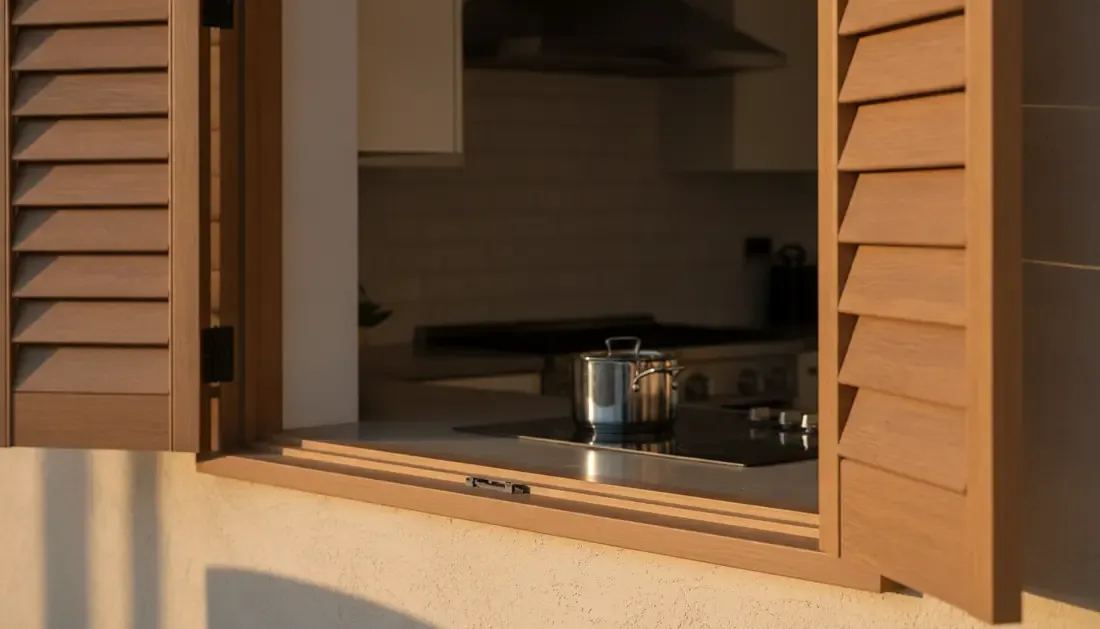
A window beside the range has a different limit. Heat and airborne grease settle on nearby surfaces. A treatment that hangs into the cooking zone is a safety problem. Keep the covering and its hardware outside the clear space the range maker expects. If you cannot confirm that clearance, choose another product. You can also leave that pane uncovered and treat a nearby window instead.
Grease is a cleaning problem more than a style problem. It lands as a film on the lowest surfaces first, including the sill and the bottom rail. A finish you can wipe with mild soap is more useful there than a textured weave that holds oil. Ask to see the edge of the sample, not only the face. Seams and end caps collect the film people miss on a showroom board.
Do not treat heat control and grease control as the same feature. A darker fabric can cut glare. It does not, by itself, prove a cooler kitchen or a specific drop in temperature. If insulation matters, ask for the product specification rather than assuming a cell, a slat, or a blackout liner will block heat. For product types, compare custom shade options with custom shutters only after the opening's limits are clear.
What works on a pass-through or patio slider?
A pass-through is a working opening, not just a window. People pass plates, look into the next room, and want light on the counter. A full-height covering that only works fully open or fully closed gets left in the wrong spot. A mid-rail or a shade with a real middle stop is more useful. It keeps the counter bright. It can still cover the lower glass after dark.
Measure the pass-through as its own opening. Counter depth, pendant lights, and a raised bar can all block a wand or a tilt rod. If two people use the pass from both sides, ask which side the controls should face. An outside mount may be the only way to clear a thin frame, but it should not swing into the walkway.
Patio sliders in Temecula kitchens often face a yard or a side court. Afternoon sun on that glass is common. The covering has to stack or rise without blocking the handle. It also has to clear the floor track. Wide glass may need more than one panel. Look at where the stack lands when the door is open. It should not cover a light switch or a cabinet pull.
If the slider is the main path to a covered patio, think about how often it stays open. A treatment that looks right only when the door is shut will annoy you on mild evenings. Note the handle height and the screen door, if there is one. Two layers in one opening need their own clearance. Do not assume a single outside mount will clear both.
Privacy on a slider is usually an evening problem. Daytime glare is a different one. A covering that softens the view of the patio can still leave side gaps. Stand in the kitchen after the lights are on, if you can, and note what a neighbor would see. Southern California blind styles are one option for wide glass. They are not automatic. A shade or shutter may fit the track and the handle better. See how wide-opening projects look in the project gallery before you lock a style.
How should you use the Temecula in-home visit?
Photos and a tape measure from the hallway are a start. They miss the faucet arc and the range clearance. They also miss the hour when west glass glares across the island. An in-home visit is where those details get checked against samples. Vineyard includes measuring and installation in its service offer. Confirm what your project includes when you book. Ask about free measuring and free installation. Do not assume a free estimate is included unless it is written on your quote.
Bring the openings, not a product name. A useful visit looks at four things:
- Sketch each opening and note sink, range, pass-through, or slider.
- Mark morning light, afternoon glare, and whether the glass faces a street.
- List what must stay clear: faucet, burners, handle, and door swing.
- Hold samples at the glass and wipe the one you are considering.
- Ask which mount fits the frame depth you actually have.
Samples lie under showroom lamps. Hold a slat or a shutter panel at the sink in the late afternoon if that is when you cook. Look from the yard side too. A light color that feels clean at noon can read bright at night when interior lights are on. Mobile showroom service exists so you can make that check in the kitchen, not from a small screen.
Temecula afternoons are the test that matters for west and south glass. Visit Temecula Valley's climate notes describe warm, dry summers and bright midday sun, with average summer highs near 88 degrees. That is a glare and timing fact, not a promise that any covering will cool the room. If you cook at 5 p.m., book the sample visit near that hour when you can. Morning light will flatter a color that feels harsh later.
If the home is still in construction, measure after the counters and backsplash are in. A tile lip or a thicker counter can steal the space an inside mount needed. For a remodel in Temecula, Murrieta, or nearby Riverside County cities, book the measure after those finishes are set. Service across the wider area is listed on the areas we serve page.
What should the quote say before you order?
A kitchen quote is hard to compare when one price is a sink window and another is the whole room. Ask for each opening on its own line. The line should name the product, the mount, and the control. It should also say what measuring and installation include. A market range such as $250 - $600 per window can help you budget window coverings in general. It is not a price for your sink, your slider, or a motor. Custom size, material, and hardware move the number.
Read these items on the written quote:
- Opening list. Sink, range, pass-through, and slider are separate lines, with width and height.
- Material. The quote names the surface you will wipe, not a style word alone.
- Mount. Inside or outside is marked, with a note if the frame is too shallow.
- Clearance. Range distance, faucet, handle, and stack location are acknowledged.
- Control. Manual or motorized is specified, including where a wand or remote lives.
- Service. Measuring and installation are listed as included or priced.
If two quotes use different materials on the sink, they are not the same job. Ask the writer to mark any change in plain language. Lead time and payment terms belong on that same page. When you are ready to schedule the visit, use the contact page and point to the openings you listed.
Motorization can help a tall pass-through or a slider that is awkward to reach. It is optional on a small sink window you already touch while washing dishes. Ask about power, charging, and what happens if the control is near water. For a broader look at powered shades, read the automatic window shades guide. Decide room by room. A motor on every kitchen opening is rarely the best use of the budget.
Whole-home shade choices, including cellular styles for other rooms, are a separate decision. This kitchen plan should not turn into a house-wide fabric comparison. If another room needs a different covering, note it and keep the kitchen quote tied to the openings above.
Call Vineyard Blind & Shutter at (951) 757-4188 to schedule a Temecula kitchen measure.


