One-way vs split draw vertical blinds is a layout choice, not a style choice. A one-way draw gathers every vane on one side. A split draw, also called a dual or center opening on some order forms, gathers vanes on both sides and opens through the middle. The better one is the draw that leaves your active sliding panel and handle clear.
Call Vineyard Blind & Shutter at (951) 757-4188 for free measuring and free installation.
What does one-way vs split draw vertical blinds mean?
Both options use the same kind of vertical vanes. The difference is where those vanes go when you open the door.
Q: What is the difference between a one-way draw and a split draw? A: A one-way draw stacks every vane on the left or the right. A split draw divides the vanes into two stacks, one at each end, and opens from the center.
A manufacturer's order form may list the choices as one way right, one way left, dual stack, and center stack. Those names are not universal. Ask the supplier to say, in plain words, which side the vanes will sit on when the blind is fully open.
Controls are a separate choice. On some cordless wand systems, one wand both rotates the vanes and traverses them. A dual stack may put the control on the left, the right, or on both ends. Confirm that on the quote. Do not assume a wand and a cord system move the same way.
If you still need the broader product overview, start with the guide to vertical blinds for sliding glass doors. This page stays on the draw and the stack.
How does a one-way draw open a sliding door?
A one-way draw is the simpler path when one side of the opening is the side you actually use. All of the vanes travel to the other side. The active panel, the handle, and the walking path stay open.
That works well on a two-panel patio door when only one panel slides. Stack the vanes on the fixed panel. Then the moving panel can open without a pile of vanes in front of the handle.
It is a poor fit when the only free wall is on the active side. A full stack is wider than a single vane. If that stack covers the handle, a light switch, or the panel you open every day, the blind will fight the door.
- Choose one-way when one panel is fixed and the opposite side has room for the whole stack.
- Name the side on the order: left stack or right stack, as you look at the door from inside.
- Check the open position, not the closed one. Closed vanes hide the problem.
- Watch the handle. A projecting handle can sit inside the stack even when the glass looks clear.
One-way can also be the only option on a narrow opening. One custom-vertical guide lists an inside-mount one-way minimum of 13 3/8 inches, against a dual-stack minimum of 25 7/8 inches and a center-stack minimum of 48 inches. Those limits belong to that product line. Ask for the minimums on the product you are ordering.
How should you choose one-way vs split draw vertical blinds?
Stand at the door and open the panel you use. Note which hand reaches the handle, and where a person stops while the panel slides. The stack has to live somewhere that person is not standing.
- Mark the active panel. On a two-panel door, one side usually stays fixed. The stack should prefer the fixed side.
- Face the door from inside and write "left" or "right" for the stack. Say which way you are facing so the order is not reversed.
- Look beside the frame. A return wall, curtain, or cabinet can steal the space a one-way stack needs.
- Open the door fully and see whether the handle still clears the spot where vanes would gather.
- Try the center. If both side walls are tight, a split may keep each stack smaller and open in the middle.
A split draw is often easier when the door is wide, both ends have a little wall, and people walk through the center. It can be awkward when the only sliding panel is on the left or right. The center opening may not line up with that panel, so you still push vanes aside to get out.
There is a second split-style option on some forms: center stack. Do not treat "dual" and "center" as the same line item. Ask which one is being quoted, and ask where the control sits. A dual stack on one product line requires an even number of vanes, which can change the layout by one vane.
| Door situation | Draw to ask about | What to confirm |
|---|---|---|
| One sliding panel, with an open wall on the fixed side. | One-way, stacked on the fixed side. | The handle and the switch stay outside the stack. |
| A wide door, with traffic through the middle. | A split or a center opening. | Both stacks fit. The center lines up with the walkway. |
| A tight wall on the side you need clear. | Usually not a one-way draw to that side. | Ask if a split, or another mount, leaves the panel usable. |
| A narrow opening. | Often one-way only. | Check the product minimum for a dual or center stack. |
Bring this table to the measuring visit. It is a decision aid, not a substitute for the product's own stack chart. A good measurer will stand at the open door and point to the stack before writing the side on the form.
Where will the vanes stack when the door is open?
Stack width is the detail that surprises people. A one-way stack holds every vane, so it is the wider pile. A split puts about half the vanes on each end, so each pile is smaller, but you now have two of them.
Manufacturers publish a vane-count and stacking chart for this. The chart is for that headrail, vane width, and mount. Do not reuse a chart from another brand, and do not guess a deduction. Ask the supplier to read the stacked width off the chart for your finished size.
Outside mount changes the math because the blind is wider than the glass. One patio-door guide recommends overlapping the opening by at least 4 inches on each side for privacy, and thinking about stack width so the door stays easy to pass. That overlap is guidance from that guide, not a rule for every headrail. If you add overlap, ask how much of it becomes stack rather than clear opening.
Also ask:
- How wide is the stack when the vanes are fully open?
- Does that width include the wand or a carrier?
- Will the stack cover trim, a handle, or a wall switch?
- Is the chart for outside mount only? Some charts are.
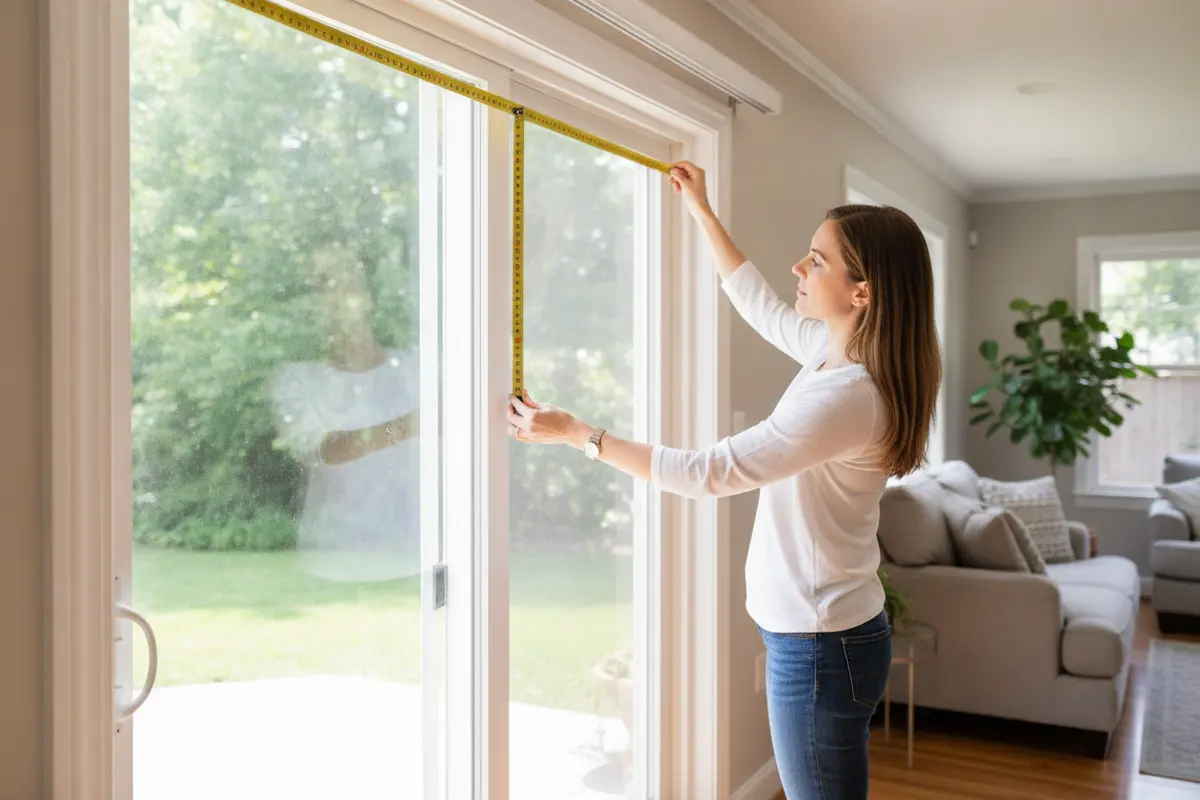
For a floor-length outside mount, that same guide says to deduct 1/2 inch for clearance and to extend the blind at least 3 inches above the opening. Inside mount is different. Measure the width at the top, where the headrail goes, and the height at the left, center, and right. Use the smallest height. One guide asks for a minimum inside depth of 2 1/2 inches and tells the buyer not to take their own deductions, because the factory clears the sill by about 1/4 to 1/2 inch. Follow the sheet for the product in your quote.
Which control should you pair with the draw?
The draw decides where the vanes go. The control decides how you move them. Pick both before the order is written.
A cordless wand is the simplest match for many patio doors. On at least one current custom-vertical line, the wand is the standard control: it rotates the vanes and traverses them, and it removes dangling cords and chains. A dual-stack version of that line can place a wand at one end or at both ends. Two wands can help when the door is wide. They can also crowd a handle if the wand hangs on the active side.
Cord or chain controls still show up on some products. If the quote includes them, ask where they hang when the blind is open and whether they cross the walking path. The U.S. Consumer Product Safety Commission says children can be strangled by pull cords, continuous-loop cords, inner cords, or other accessible cords longer than 8 inches. CPSC data in its November 2, 2022 standard announcement put the toll at about nine children under 5 each year. CPSC's advice is to choose cordless coverings when children are in the home.
That announcement is a safety warning, not a promise that every custom blind is cordless. Ask which control is on your line item. If a cord is part of it, ask how it is restrained and whether a cordless wand is available for that same draw.
Motorized traverse is a third route. Treat it as its own product question, not as a draw type. You can compare power and control styles on the custom shades page, then confirm the vertical-blind headrail actually offers that control.
What should the quote say before you approve it?
A draw is easy to reverse on paper and expensive to reverse after the headrail is built. Read the proposal for these items before you approve it:
- Draw name in the supplier's words: one-way left, one-way right, dual, or center.
- Your words next to it, such as "stack on the fixed panel" or "open at the center."
- Control type and side, including whether a wand is one-sided or on both ends.
- Mount, inside or outside, plus any overlap.
- Stacked width from the product chart, and the clear opening that leaves.
- Vane count, if a dual stack needs an even number.
Ask what happens if the opening is out of square or the handle projects farther than the photo showed. The person who measures should confirm the draw on site, not only the width and height.
Vineyard Blind & Shutter measures and installs custom window coverings in San Diego, Riverside, and Orange counties. In-home measuring and installation are included. See mobile in-home service for the visit, and the vertical blinds page for the product. For other blind styles in the same rooms, the custom blinds overview is the broader catalog.
Use the contact page if you would rather send photos of the door first. Include the active panel, the handle side, and which wall is free. That is enough to start the draw conversation.
Take one straight-on photo of the closed door and one with the panel open. Add a close-up of the handle and a photo of each side wall. Note which panel is fixed. Those photos will not replace a measure, but they can catch a left-versus-right mix-up before anyone drives out.
Call Vineyard Blind & Shutter at (951) 757-4188 to schedule free measuring and free installation.