
Choosing sliding glass door blinds for rentals means balancing daily access, privacy, durability, and lease restrictions. The right treatment should move easily, fit the opening, and suit the room’s light needs. Start by checking what your property owner permits and whether existing hardware can be reused.
Q: What matters most when choosing a rental sliding-door treatment? A: Confirm permission and mounting limits first, then compare how each option clears the doorway, controls sightlines, and suits daily use.
What should you check before choosing sliding glass door blinds for rentals?
Start with the lease and a conversation with the property owner or manager. A treatment attached to an existing headrail may be easier to approve than drilling new holes, but do not assume it is allowed. Ask whether a new track, replacement hardware, or no-drill option is acceptable. Get written approval when the change is more than a simple replacement.
- Check whether the current treatment and track belong to the property.
- Ask if drilling into the frame, wall, or ceiling is permitted.
- Clarify who removes or restores hardware at move-out.
- Photograph the existing setup before changing it.
- Ask about any door, screen, or access requirements.
Next, inspect how the door opens. A single sliding panel, a multi-panel patio door, and a door with a screen can require different clearances. Identify the fixed and moving panels. Note whether furniture, a nearby wall, or the handle limits the space available for a treatment as it stacks open.
For a broad comparison of styles, see Vineyard’s guide to blinds, shutters, and shades. Then focus on options designed to work across a wide opening.
Which treatment styles work well beside a sliding door?
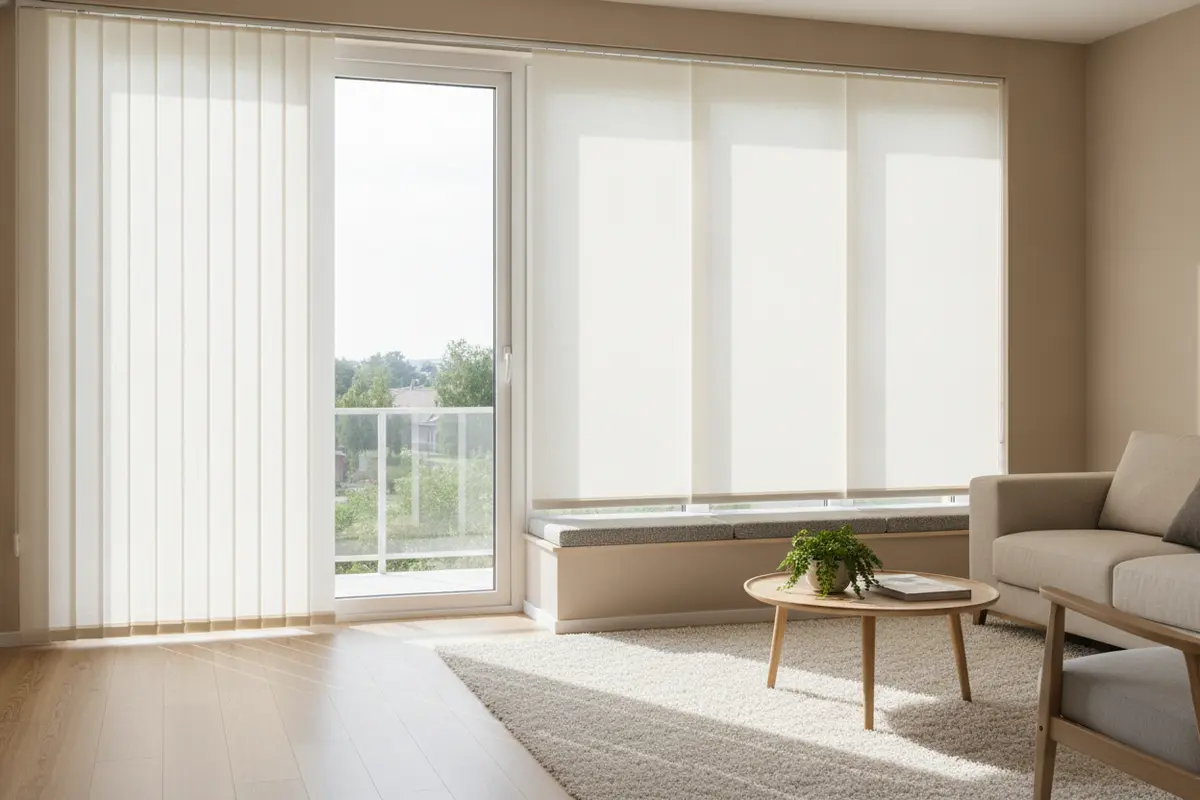
Vertical blinds are familiar because the vanes turn for light control and travel along a track. Depending on the track, they can draw to one side or split from the center. Ask how wide the gathered stack will be and whether it clears the handle and traffic path.
Panel-track shades use broad fabric panels that glide along a track. Their clean, simple appearance can suit a contemporary room, but panel width and count affect how much glass remains covered when open. Compare fabric openness and privacy characteristics rather than assuming every panel blocks light equally.
Some vertical cellular and specialty shade systems are made for large openings. Confirm the specific product is suitable for the door dimensions and expected use. Horizontal blinds can be less convenient over a frequently used door because lifting a wide blind may be cumbersome. A treatment meant for a standard window may not work well simply because its color matches.
Imagine the daily routine before deciding. Do children or pets pass through often? Is one side used more? Must the covering open fully, or is partial coverage enough? These practical details can matter more than a product photo.
How do the main options compare?
| Option | Door access | Questions to ask | Rental consideration |
|---|---|---|---|
| Vertical blinds | Vanes rotate and draw along a track | Which way does the stack travel? Does it clear the handle? | Can existing hardware be reused? Are replacement vanes available? |
| Panel-track shades | Wide panels slide across the opening | How much glass remains covered when open? | Does the track need new holes or another mounting surface? |
| Specialty vertical shade | Designed to move across a large opening | Is the model suited to this door size and use? | Confirm mounting method and owner approval. |
| Horizontal blind | Typically raises away from the glass | Will lifting a wide blind be practical? | Check weight, clearance, and support. |
Costs vary with opening dimensions, material, operating system, and installation needs. A made-to-measure treatment can differ in price from an off-the-shelf product. Request an itemized quote that identifies the treatment, hardware, measuring, installation, and removal or disposal work. Ask which components remain with the property if you move.
How should you measure a sliding glass door?
Measure only after confirming the approved mounting approach. For a replacement in an existing track, record the track’s usable width and the height from the intended mounting point to the floor. For a new installation, note the opening width and height, plus available space above and on each side. Measure in more than one place because floors and walls may not be perfectly level.
- Identify the moving panel, fixed panel, and direction the door slides.
- Measure the glass opening and the full area you want covered.
- For a new fit, measure height at the left, center, and right.
- For a replacement, record track, bracket, or headrail dimensions.
- Note handles, locks, trim, nearby walls, flooring, and furniture.
- Take clear photos from inside and close-ups of current hardware.
Write down whether each measurement describes the glass, frame, or desired coverage area. These are not interchangeable. If considering a custom treatment, ask the provider to verify final dimensions before production. Vineyard’s mobile window treatment services include in-home measuring and installation, useful when the opening or mounting details are not straightforward.
How can you balance privacy, daylight, and access?
For a room facing a neighbor or public walkway, consider how much coverage you need when the door is closed and whether you want to preserve a view during the day. Adjustable vanes change the angle of incoming light. Fabric panels offer a different balance of view and privacy depending on their material. Ask to see samples in the room at different times of day.
Light control and insulation are separate considerations. A covering that reduces direct glare is not automatically a verified way to reduce heat transfer. If energy performance matters, ask for product-specific documentation rather than relying on a general claim. Compare suitable products on the custom shades page and ask which options are designed for wide openings.
For a door used many times each day, test the operating action. Check that the wand, cord, or other control is reachable without standing in the doorway. Ask how the treatment behaves with the screen door open. Keep walkways clear and avoid arrangements that snag on handles or catch on furniture.
What should renters ask before ordering or installing?
Use the quote discussion to confirm more than appearance. Ask what is included, what the installation requires, and who removes the old treatment. If the landlord expects the original hardware to remain, ask whether it can be stored safely and reinstalled later.
- Is the treatment sized for this opening and mounting location?
- Does the quote include hardware, measuring, and installation?
- Will installation use the existing track or require new holes?
- How should the material be cleaned and operated?
- Can individual components be serviced or replaced?
- What must be removed or left in place when the lease ends?
Browse the window treatment gallery for ideas, then note what you like about each example: openness, color, panel width, or how the treatment stacks. A photo is a starting point, not a guarantee that the same configuration suits your door.
How do you keep the choice practical after move-in?
Keep the owner’s approval, order information, care instructions, and installation notes together. If the treatment is removable, retain its original parts and label stored hardware. Clean according to the material and manufacturer instructions. Avoid harsh products or excess moisture unless the care guidance allows them. Periodically check that the track is clear and controls move without force.
When choosing between a temporary option and a made-to-measure system, weigh how long you expect to stay, how frequently the door is used, and whether you can take the treatment with you. A portable solution may be sensible for a short tenancy. A custom fit may make more sense when the owner approves a lasting improvement. The best choice must suit both the lease and the household’s routine.
What would a renter’s selection process look like?
Consider a renter whose patio door is used several times a day and opens beside a sofa. The current vertical track is worn, and the landlord has not yet approved replacement. The useful next step is not ordering a new treatment based on a photograph; it is documenting the existing hardware and asking what may be changed.
Once permission is clear, the renter can compare a replacement vertical system with a panel track. If the stack would occupy the sofa-side space, ask whether the track can draw the treatment to the opposite side. If neither arrangement clears the handle comfortably, reconsider panel count or another product rather than forcing a poor fit. The decision should account for how much uncovered glass is acceptable when the treatment is open.
For a second example, imagine a door used less often in a bedroom. Privacy at night may matter more than fully clearing the opening every hour. The renter can compare fabric opacity, side gaps, and the ability to open the panels for daylight. Samples held near the glass at dusk can reveal how the material looks under the room’s lighting. The same product need not suit a high-traffic living room and a quiet bedroom equally well.
These examples show why a short written checklist helps. Record the opening, use pattern, clearance limits, preferred light level, landlord’s answer, and whether the hardware can be reused. That list keeps the conversation focused on fit and operation instead of color alone.
How can you document approval and avoid a move-out dispute?
Save the owner’s response with the lease documents, and make the request specific. Include a photo of the doorway, the proposed mounting location, whether the existing track will stay, and whether any holes or adhesive will be used. Ask who owns the replacement treatment and what should happen to the original parts. A clear written record helps prevent different expectations about restoration later.
If the property has preservation restrictions or a historic designation, ask whether separate review applies before altering windows or nearby trim. The City of San Antonio’s wood window guidance describes approval requirements for window repair and replacement on historically zoned property. That example is specific to its jurisdiction; it is not a rule for every rental. The practical point is to check applicable property rules rather than assume a lease answer covers every restriction.
Keep dated photos before and after the work, along with the order details and any installation notes. If you remove existing hardware, store it in a labeled box and record its condition. Before moving out, compare the treatment with the owner’s written instructions and arrange any agreed reinstallation early enough to address missing parts or a fit issue.
What should you confirm on installation day?
Before work begins, compare the delivered treatment with the approved plan. Confirm the mounting position, operating side, and direction the panels or vanes will stack. Keep the doorway clear while the track is fitted, and point out the handle, screen, trim, or nearby furniture that could affect movement.
After installation, operate the treatment through its full range while the installer is present. Open and close the sliding door and screen, check that neither catches, and make sure the covering can be moved without force. Ask for basic care instructions and how to report a problem. If the setup differs from the landlord-approved plan, pause and resolve the difference before treating it as final.
For a professional review of dimensions and product choices, contact Vineyard Blind & Shutter to ask about in-home measuring and installation.
What should you confirm about older or restricted properties?
A rental may have rules beyond the lease, especially where historic preservation or a condominium association governs visible changes. Before attaching a headrail to trim or replacing hardware, ask the owner whether building or local approval is also needed. Keep the request narrow: describe the proposed treatment, mounting point, and whether the work changes the window, door frame, or surrounding trim.
The San Antonio historic wood-window guidance is an example of a local review process, not a universal rental requirement. Its relevance is limited to that jurisdiction and to covered properties. For most renters, the takeaway is simply to distinguish a removable interior covering from any work that alters a regulated window or frame. If the answer is unclear, pause and have the owner clarify the approval path before ordering.
Also ask whether an existing treatment must remain available for future tenants. A property manager may want the original blind stored rather than discarded. Label the parts, photograph their condition, and record the storage location so the move-out handoff is straightforward.
How can you compare a temporary fix with a custom fit?
A temporary solution can be attractive when the lease is short or the owner will not approve new hardware. Evaluate it by the same practical criteria as a permanent system: does it cover the intended glass, move aside for access, stay secure during normal operation, and avoid interfering with the handle or screen? Ask the product maker how it is mounted and what surfaces it suits; do not assume adhesive strips or tension devices will support a wide covering.
A custom treatment can be considered when the opening is an unusual size, the current track is damaged, or the door is central to the room’s daily use. The trade-off is that made-to-measure hardware may need a specific mounting location and may be harder to take to another home. Ask whether the treatment can be removed intact, whether the owner wants original hardware retained, and what restoration work would be expected when the tenancy ends.
Compare the two options using a short decision record. Write down the estimated time you expect to stay, the number of daily door openings, the amount of clearance needed, the owner’s approval, and the total quoted work. Avoid comparing only the initial product price: installation, removal, replacement parts, and storage of original hardware can affect the overall effort.
Call Vineyard Blind & Shutter at (951) 757-4188 to schedule a measure for your sliding glass door.
With permission confirmed, careful measurements, and a clear understanding of daily use, you can choose a rental-friendly treatment that feels considered rather than improvised.


