Vertical blinds for wide windows can provide broad coverage while allowing the slats to turn for changing light and privacy. They are a familiar option for sliding doors and large openings, but the right result depends on careful measurements, a suitable material, and enough clearance for the blinds to stack when open.
Call Vineyard Blind & Shutter at (951) 757-4188 to discuss your wide window.
Why consider vertical blinds for a wide window?
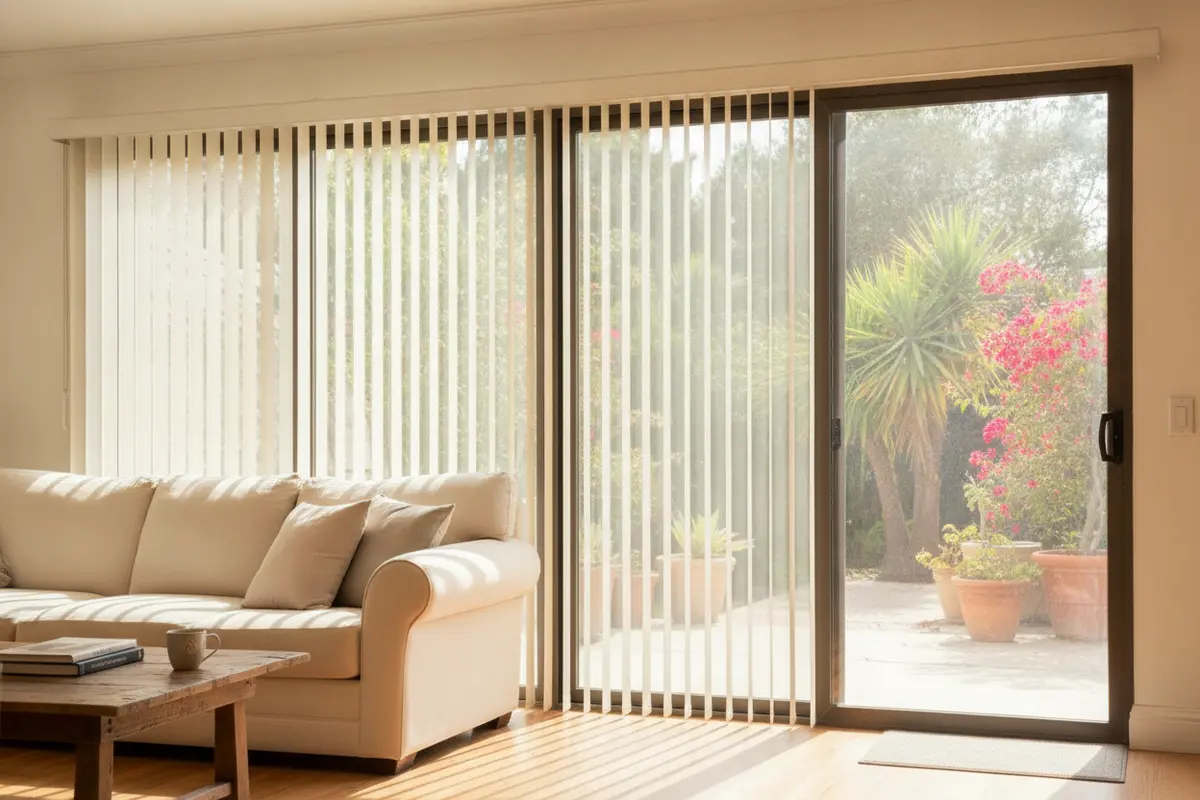
Wide windows create a practical challenge: a covering must span the opening without making everyday access difficult. Vertical blinds use upright louvers suspended from a headrail. You can rotate the louvers to adjust the view and incoming light, then draw them to one side or split them toward both sides, depending on the selected operating layout.
This arrangement can work well for a large picture window, a patio slider, or an opening used throughout the day. Unlike a single wide horizontal blind, the vertical format divides the covering into manageable slats. The individual louvers can turn, so you can make a small adjustment rather than raising or lowering the entire treatment whenever the light changes.
There are trade-offs. The headrail is visible, and the louvers need room to stack when open. Air movement or frequent passage can also shift loose slats. Before choosing, decide how often you use the opening, which direction you want the louvers to draw, and whether the stack can sit beside the glass without blocking a handle, walkway, or useful view.
For a broader look at custom options, see Vineyard's custom blinds service and its comparison of window-covering types.
How do you measure a wide window for vertical blinds?
Accurate measuring starts with the mounting plan. An inside mount sits within the window recess. An outside mount covers the opening from the wall or trim. The available depth, the shape of the trim, the handle position, and nearby doors or furniture can affect which setup is practical. Do not assume that a wide opening is perfectly square.
- Choose the mount. Look at the recess from top to bottom. Check whether there is enough clear depth for the headrail and whether any handles, locks, or trim project into that space. If an inside mount is not suitable, consider an outside mount with enough overlap to cover the edges.
- Measure the width in several places. For an inside mount, record the width near the top, middle, and bottom of the opening. For an outside mount, measure the area you want covered and include the planned overlap. Use the mounting instructions for the specific product to determine how to interpret those measurements; do not automatically subtract or add a standard amount.
- Measure the height at multiple points. Record the left, center, and right heights from the intended headrail position to the planned bottom. Note a sill, floor, or threshold and decide how much clearance is needed so the louvers do not drag or obstruct movement.
- Check the stack and draw direction. Mark where the louvers will collect when open. A one-way draw stacks at one side; a split draw divides the stack. Confirm that the stack will not interfere with a door handle, a cabinet, or the main walking path.
- Write down obstacles and details. Note uneven trim, a nearby wall, a projecting sill, a sliding door panel, or any feature that may affect installation. Take a straight-on photo and a side photo to help explain the opening.
For wide or unusually shaped openings, a small measurement error can become noticeable across the full span. Keep your measurements labeled with the room and window, and distinguish the visible glass from the full area you want the blind to cover. A professional measurement helps confirm the mount, dimensions, and clearance before a custom order is placed. Vineyard includes free measuring and free installation with its service.
Avoid measuring only the glass if you plan to cover the frame or extend beyond it. Similarly, do not assume the floor or sill is level: recording the height in more than one place can reveal differences that affect the finished appearance. Write measurements in a consistent unit and label each one clearly as width or height. If more than one wide window is in the room, give each opening a separate label instead of relying on memory.
It also helps to test the intended open position before settling on a design. Stand where you normally enter the room and picture the louvers gathered at the chosen side. If that stack would cover a favorite view or collide with an adjacent wall, discuss a split draw or another layout. On a door, check that the blind can be moved aside without making the handle difficult to reach. These simple checks connect the measurement to the way the room is actually used.
For a more reliable measuring note, make a small sketch of the opening and label its top, bottom, and sides. Mark the side with the handle, the panel that slides, and any wall return beside the frame. If the window has a deep sill or a floor-level threshold, include its projection on the sketch. A photo alone can make it hard to judge depth, while a few written dimensions help explain what is in front of and beside the glass.
Before an appointment, clear objects away from the sill and the nearby floor area where possible. That makes it easier to inspect the recess, reach the frame, and test how the proposed blind may travel. If there are several openings, indicate whether you want them to look consistent or need different operation for each. Similar-looking windows can have different clearances, so each opening still needs to be checked individually.
Which materials suit vertical blinds for wide windows?
Material affects the look, feel, cleaning routine, and how the louvers behave during daily use. Ask to see a sample in the room where the blind will be installed. The same color can appear different next to your flooring, wall paint, and daylight than it does in a showroom or on a screen.
| Option | What to consider | Often worth comparing when |
|---|---|---|
| Vinyl | Easy-to-wipe surface and a practical appearance; compare the feel, finish, and available colors. | You want a straightforward surface for a busy opening or a room where occasional wiping is useful. |
| Fabric | Softens the appearance and comes in different textures; check care instructions and how the material filters light. | You want a softer visual effect and have a cleaning routine that suits the selected fabric. |
| Composite or faux wood-style options | Compare weight, finish, and how the vertical slat design looks beside nearby trim or furniture. | You want a coordinated look and can review samples before selecting the finish. |
| Other custom vertical options | Ask about the product's slat dimensions, available colors, operation, and care guidance. | Your opening has specific design needs or you want to compare more than one material in person. |
These are comparison prompts, not a promise that every material is offered in every configuration. Product availability and operating details vary. Ask which options fit the opening, and request product-specific care guidance before making a decision. You can explore the company's blinds, shutters, and shades or browse its window treatment gallery for examples.
When you compare samples, look beyond the color name. Hold each sample beside the frame and nearby wall, and view it in both daylight and the room's evening lighting. Check whether a fabric's texture is visible from across the room and whether its surface feels appropriate for a high-touch doorway. Ask how the material is cleaned, whether it can be spot-cleaned, and what care products should be avoided. The answers can help you compare the routine of ownership, not just the initial appearance.
Think about how much visual continuity you want across the window. A lighter material may make the opening feel less visually heavy, while a contrasting finish can emphasize the window as a feature. Neither is automatically the better choice; the surrounding finishes and the size of the room matter. If multiple windows share a wall, compare samples together so you can see whether one material and color will make the whole area feel coordinated.
What operating details matter on a wide opening?
Think about the normal route through the room. If the opening is a frequently used patio door, the blind should clear the path when opened. Decide whether a one-way draw or split draw better matches the door's active panel and your furniture arrangement. Ask how the control will be positioned and whether it will be easy to reach without leaning over a counter or stepping around furniture.
Consider how you prefer to adjust light. Rotating louvers can shift the view and light without fully opening the treatment. Drawing the louvers aside gives a more open view, but the gathered stack occupies part of the wall or glass area. If you often move between full coverage and an unobstructed doorway, test how the proposed stack and draw direction will work in the room.
For powered operation, ask which motorization options are available for the specific product, how the controls work, and whether the system is compatible with your needs. Do not assume that every vertical blind can be automated or that every control works the same way. Vineyard also offers custom shades, including motorized shade options, if you want to compare a different format for the opening.
Map the operation to the people who will use it. A control that is easy to reach from one side may be awkward from the usual seating area or the route into the yard. If you expect to adjust the louvers several times a day, consider the reach, the motion required, and the position of nearby furniture. For a powered system, ask how it is operated during an ordinary day, what happens if the power or control is unavailable, and what maintenance the manufacturer recommends.
It can help to describe a typical use sequence: for example, opening the door in the morning, adjusting glare during the afternoon, and closing the treatment for privacy in the evening. Ask the product specialist to demonstrate those movements with a sample or explain the intended control layout. This makes the conversation concrete and can reveal a mismatch before a product is selected. Also consider whether the louver direction you prefer when closed affects your view from the room or the appearance from outside.
How do vertical blinds compare with other wide-window coverings?
Vertical blinds are one option, not the only way to cover a broad span. The best comparison depends on whether you value an adjustable view, a softer appearance, a clean open-door path, or a treatment that becomes part of the room's architecture. Consider the full opening and how you use it rather than choosing by appearance alone.
| Window treatment | Potential advantages | Questions to resolve |
|---|---|---|
| Vertical blinds | Louvers rotate for light and privacy and can draw aside across a wide opening. | Where will the stack sit? Which material and draw direction suit the room? |
| Roller shades | A simple, streamlined surface; separate shades can be considered for different sections. | Will one wide shade or multiple units work better? How much access to the view do you need? |
| Sliding panels | Broad fabric panels can create a clean, contemporary look across a large span. | Is there enough space for panels to stack, and does the panel movement suit the doorway? |
| Plantation shutters | A structured appearance with adjustable louvers in a more architectural frame. | Will the frame and panels fit the opening and clear the door, trim, and nearby furniture? |
Each format has different operating and installation requirements. For example, shutters may need room for panels to open, while shades and panels need a suitable place to gather. Vineyard's custom shutter options offer another route to compare, but a specific opening and desired operation should guide the recommendation.
Try a simple scenario comparison instead of asking which treatment is best in general. If the opening is a fixed picture window, an unobstructed door path may not matter, so appearance and light adjustment may lead the decision. If it is a patio door used throughout the day, stack location and how easily the treatment moves aside deserve more weight. If you want a nearly continuous surface across the glass, compare how shades or panels operate and where they gather. This use-first approach helps avoid choosing an attractive option that conflicts with a daily routine.
Also compare the visual effect with the room's other window coverings. A broad vertical treatment can look distinct from small nearby windows fitted with horizontal blinds or shades. That difference may be intentional, but it is worth seeing samples and discussing whether a coordinated color or finish will help the room feel cohesive. A product comparison is strongest when it includes the whole wall, not only a close view of the material.
What should you check before ordering?
Use this short checklist during a consultation or product review. It helps turn a general preference into details that can be confirmed before fabrication and installation.
- Opening use: Is it a patio door, a fixed picture window, or both? Which panel or side is used most often?
- Mounting surface: Is the recess deep and even enough for the proposed headrail, or is an outside mount more appropriate?
- Clearance: Where will the stack go? Will it block the glass, a handle, a walkway, or another treatment?
- Light and privacy: Do you want adjustable slats, a more continuous surface, or the ability to uncover the full opening?
- Material and care: What is the product-specific cleaning guidance, and how does the sample look in the room's natural light?
- Controls: Which side will controls sit on, and is manual or powered operation available for the product?
- Scope: Are you covering one opening or several windows? Confirm how each opening will be measured and treated.
- Service area: Vineyard serves customers in San Diego, Riverside, and Orange counties. Review the areas served page if you are unsure whether your location is covered.
Before you approve the order, repeat the important choices in plain language: mount type, finished coverage area, louver direction, draw direction, control location, material, and color. Ask which details are fixed by the selected product and which can still be adjusted. If one opening has a special feature, such as a handle that projects into the recess, make sure that feature is noted against that specific window rather than treated as a general room detail.
Confirm what the installation visit needs from you, too. Ask whether furniture must be moved, whether the installer will need access to both sides of the opening, and how the finished operation will be demonstrated. After installation, operate the blind several times: rotate the louvers, draw them open and closed, and check that the stack clears the doorway and nearby objects. Raising questions while the details are being reviewed is easier than discovering a clearance issue after the room is back in use.
Q: What is the most important first step for a wide window? A: Decide how the opening is used and where the blind can stack when open. Those two details help narrow the mounting, draw direction, and product style before you settle on a material.
What safety and everyday-use details should you ask about?
Window coverings should be chosen with the people and routines in the home in mind. Ask for the product's current operating and safety information, including how its controls work and what care or use instructions apply. If children or pets use the room, raise that early so the available product and control choices can be reviewed for your situation.
For general consumer-product safety information and current alerts, you can consult the U.S. Consumer Product Safety Commission. Follow the instructions supplied with the selected window covering and ask the installer to explain any operating details that are not clear.
Include cleaning and wear in the everyday-use conversation. Ask how to remove dust from the selected louvers, whether the manufacturer recommends a particular cloth or method, and how to handle a mark without damaging the finish. For a doorway used often, clarify how to move the treatment aside before passing through instead of pushing through the louvers. Small habits like these can help protect the blind and make the opening easier to use.
Call Vineyard Blind & Shutter at (951) 757-4188 to review your wide-window options.
Ready to choose vertical blinds for a wide window?
Start with the way you use the opening, then compare mounting, stack space, material, and controls. Accurate measurements and a clear plan for the open position help avoid a treatment that covers the glass but complicates the room. Vineyard Blind & Shutter provides free measuring and free installation; a review of your window can help identify the options that fit your space.