Choosing window treatments for patio doors in Lake Elsinore means balancing privacy and light control with the space needed to open the door and walk through it. The right option should move smoothly, stay clear of handles and furniture, and fit the way your household uses the room.
Call Vineyard Blind & Shutter at (951) 757-4188 to discuss patio-door options.
Q: What matters most when choosing a treatment for a patio door? A: Start with the door’s movement and walking route. Then compare stack or swing space, privacy, glare, safe operation, and how often the doorway is used.
What should Lake Elsinore homeowners check first?
A patio door is both a window and a passageway. Unlike a treatment on fixed glass, it must work around a moving panel, handles, and people carrying groceries, laundry, or outdoor gear. Observe the doorway at a busy time before comparing products.
- Identify whether the door slides, swings, or folds, and note its direction.
- Mark which panel is active and where its handle projects into the room.
- Measure the clear route between the room and patio.
- Check nearby walls, trim, furniture, rugs, and adjacent windows.
- Write down when you need privacy and when glare or an open view matters more.
For a slider, note whether the active panel travels left or right and where the covering can gather. A treatment that stacks over the frequently used side can make every trip outside awkward. For hinged or French-style doors, account for the swing arc and any handles or locks. A small clearance conflict can become a daily irritation.
Think about the room as it is actually used. If children and pets move through the doorway, test the route with the door open and closed. If a dining chair sits close to the glass, include it in the plan rather than measuring an empty opening. Taking a few photos from inside and outside can help record the layout.
Which patio-door treatments are practical?
There is no single best choice for every opening. Vertical blinds, panel-style shades, roller or cellular shades, and shutters each have different space and operating needs. Compare the movement of the product with the movement of the door instead of choosing by appearance alone.
| Option | How it uses space | Privacy and light | Question to ask |
|---|---|---|---|
| Vertical blinds | Slats turn and draw to one side; the gathered stack takes side space. | Slat angle adjusts view and daylight. | Will the stack clear the active panel and furniture? |
| Panel-style shades | Wide panels travel along a track and stack at an end. | Fabric choice changes light filtering and privacy. | Is there enough room for the panels to gather? |
| Roller shades | Lift upward, clearing the side of the opening when raised. | Fabric opacity and openness affect view and light. | Will raising and lowering it suit frequent door use? |
| Cellular shades | Raise to clear the doorway; width and stack need checking. | Fabric options vary in light control. | Does the chosen configuration fit this door’s dimensions? |
| Shutters | Panels swing or fold and need room at the sides. | Adjustable louvers help manage sightlines and daylight. | Can panels move without hitting handles or furnishings? |
Vertical blinds are familiar on wide glass because the slats can turn and draw aside. Their key planning detail is the stack location. If it gathers on the side used to enter and leave, ask whether the draw direction can be configured differently or whether another style fits better. Check how the system behaves when the door is partly open as well as fully closed.
Panel-style shades use broad fabric sections on a track. They can create a simple coordinated look, but panels need a place to stack. Roller and cellular shades lift vertically, which avoids a side stack; however, raising a wide covering each time someone uses the door may not suit every routine. Ask to see the operating method and consider who will use it.
Shutters have a structured look and adjustable louvers, but the panels must swing or fold somewhere. Check the door handle, nearby wall, furniture, and walk-through route before settling on a layout. You can compare custom shutter styles with shade options suited to a wide opening.
How do clearance and traffic flow affect the choice?
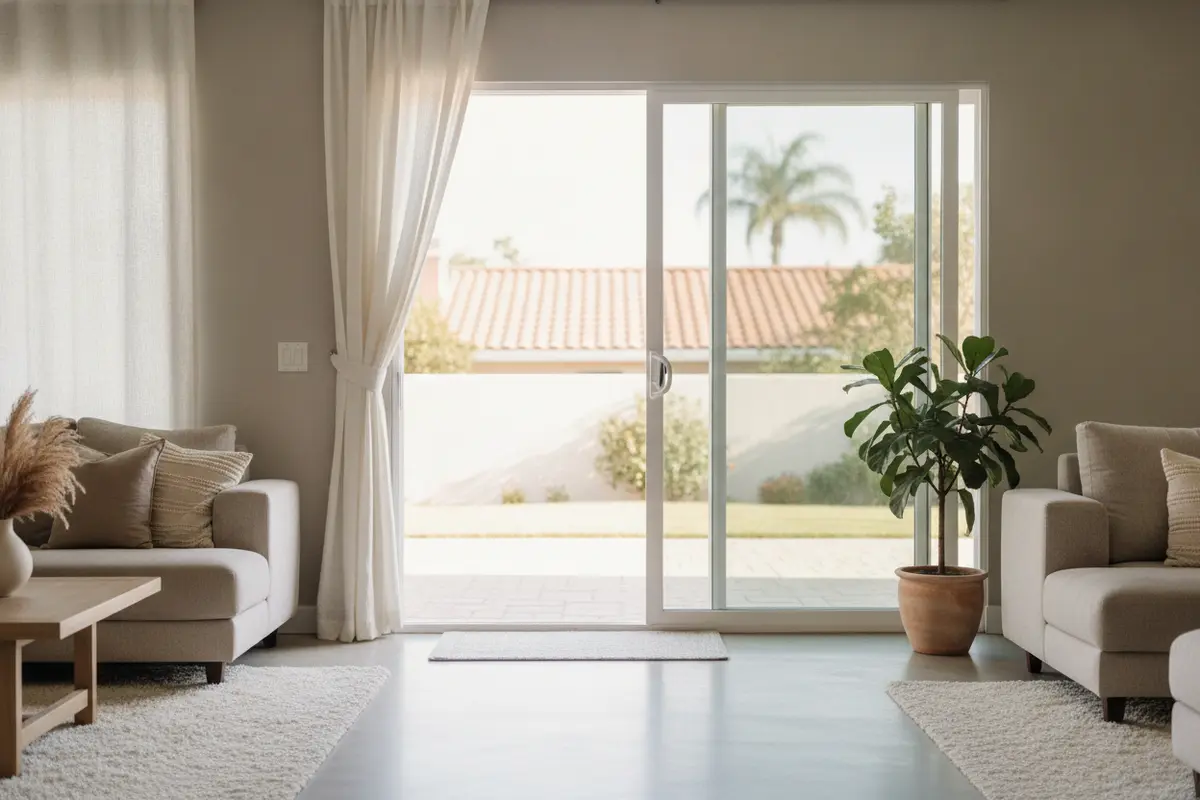
Stand inside the room and walk through the doorway several times. Imagine opening the treatment, opening the door, and passing through while carrying something. A product that looks tidy while closed still needs to be easy to move out of the way.
For a sliding panel, check whether the treatment operates independently of the door and whether a wand or control could snag on the handle. For a swinging door, make sure the treatment does not obstruct the handle or collide with the moving panel. Pay attention to the gathered or folded position: that is often when the treatment occupies the most space.
Measure the full opening and available space on both sides. Include trim, nearby windows, and furnishings that cannot move. If the opening is unusually tall or wide, or has a sidelight, note each section separately. A simple sketch with the active panel, handle, and desired stack side can prevent misunderstandings when comparing configurations.
Use the doorway at different times of day. Morning light may be comfortable while afternoon sun causes screen glare. A treatment that is quick to adjust may matter more in a high-traffic family room than one that is rarely opened. If the door is used constantly, prioritize a configuration that clears the path without requiring several awkward steps.
How should you balance privacy, glare, and insulation?
Think about the room’s conditions at different times. A patio door facing neighbors or a frequently used outdoor area may need privacy at night. Bright afternoon light may create glare on a television or computer screen. These are separate needs, so consider the fabric, slat design, and operating position that address each one.
Adjustable slats can admit daylight while limiting a direct view, although the result depends on angle and sightline. A shade can be raised to restore the view, while its fabric affects how much light passes through when lowered. Ask to see samples in the room or near the glass. A color that looks neutral in a catalog may appear warmer or cooler beside your flooring and wall color.
Do not assume a dark or room-darkening fabric automatically keeps a room cooler. Light control and heat reduction are not the same claim. If heat reduction matters, ask for documentation specific to the selected product and installation. The U.S. Department of Energy explains that energy-efficient window coverings can help manage heat gain and loss, while the result depends on the covering and how it is used: Energy Efficient Window Coverings. Compare product-specific information rather than treating color or opacity as proof of thermal performance.
For a broader overview of product types, review the differences among blinds, shutters, and shades. The best fit for a patio door still depends on its movement, dimensions, and the room’s priorities.
What should families consider for child and pet safety?
Look closely at the operating method. Ask about cordless or motorized configurations appropriate to the chosen product, and keep controls out of reach where possible. Follow the manufacturer’s safety and use instructions after installation. Do not leave loose operating parts where a child or pet can pull, chew, or become tangled.
Pets may press against glass to look outdoors, so consider how fabric or slats behave when the door is used often. A material that appears sturdy is not automatically pet-proof. Ask how to clean it and whether the mechanism suits your household’s habits. If a dog or cat regularly crosses the opening, prioritize a treatment that moves aside easily without leaving a dangling control in the path.
Think through the controls as carefully as the material. Will the person who uses the door most often be able to reach and operate the treatment comfortably? Is a wand likely to get caught in the handle? Would a motorized control be easier for a wide or hard-to-reach covering? Answers depend on the specific system, so confirm them before ordering.
How can you plan for daily operation and care?
Match the treatment to the rhythm of the home. If the patio door opens many times a day, a quick-to-clear design may matter more than a decorative detail. If privacy is needed mainly in the evening, a treatment that stays open during daylight may be convenient. Consider every regular user, including children, older adults, and anyone who may find a heavy or awkward mechanism difficult.
Motorization may be worth discussing for a wide or hard-to-reach covering, but compatibility and controls depend on the product. Ask how it operates during a power issue, where the control will sit, and whether you can open the door without disrupting access. See the guide to automatic window shades for general background.
Patio doors collect fingerprints and dust from everyday use. Ask what cleaning method is suitable for the chosen material and check the maker’s care instructions before using sprays or abrasive tools. Do not assume that every fabric, finish, or slat can be cleaned in the same way.
What should your room-planning checklist include?
Before comparing styles, collect a small set of details. This makes it easier to discuss your actual room rather than rely on a generic product description.
- Door type, width, height, and direction of movement.
- Active panel and handle location.
- Available space for a side stack or swinging panels.
- Nearby furniture, walls, trim, and adjacent glass.
- When privacy, glare control, or an unobstructed view matters most.
- How often the door is used and who will operate the covering.
- Children, pets, cleaning preferences, and control needs.
- Any heat or insulation goal to verify against product documentation.
- Photos showing the door both open and closed, plus a quick layout sketch.
Use the list to compare two or three realistic configurations. For example, a household that opens the door often might prefer a design that clears the active side quickly, while a household that values a broad unobstructed view might prefer a shade that raises vertically. In both cases, check the handle, stack, and operating effort in the actual room.
Photos can supplement measurements, but they do not replace a proper fit check. Vineyard Blind & Shutter provides mobile services, bringing product samples to the home so choices can be considered in the room. Learn about mobile window treatment services and browse the window treatment gallery for ideas.
How can you compare complete options and costs?
Patio-door treatments are custom-fit choices, so cost depends on dimensions, materials, configuration, and operation. Treat general price ranges as a starting point, not a quote for your opening. Ask what a proposal includes, such as measuring, installation, hardware, and motorization or special layout details. Compare offers with the same scope instead of comparing a basic product with a more involved configuration.
Write down the exact product and setup: material or fabric, control type, number of panels, draw direction, and where the treatment gathers. A lower figure may reflect a simpler material or a different included service. Another configuration may cost more because of its controls or custom details. Ask about care requirements and expected timing so the comparison covers use as well as the initial purchase.
Vineyard Blind & Shutter offers free measurements and free installation. A home visit can establish dimensions and review the way a treatment works with your patio-door layout. To learn more about the company’s Southern California service area, see the areas page.
How can a local fitting discussion help?
Local planning can be especially useful when the opening has unusual trim, adjacent glass, limited wall space, or constant use. A measurement visit can check physical conditions that product photos cannot show. Bring your checklist and explain which side you use most, when you want privacy, and what you need to keep clear.
Vineyard Blind & Shutter serves Lake Elsinore in Riverside County and offers custom blinds, shutters, and shades, with free measuring and free installation. Ask about the exact configuration and operating method for your door rather than assuming a single design works in every home.
Request a patio-door measurement and discuss your layout.
When you compare movement, clearance, and daily use alongside appearance, you can choose a patio-door treatment that better fits the way your Lake Elsinore home works.