
Woven shades blackout options can add natural texture while giving a room stronger privacy and light control. They are worth considering when you want the look of woven fibers but need more control than an open-weave shade usually provides. The right choice depends on the room, window, lining, mount, and the amount of light you want to keep out.
Call Vineyard Blind & Shutter at (951) 757-4188 to discuss your window covering needs.
This guide explains what blackout woven shades can and cannot do, how they compare with other treatments, and what to ask before ordering. It is written for homeowners and businesses in San Diego, Riverside, and Orange counties who want a custom fit and professional help without guessing from a small online swatch.
What are woven shades blackout options?
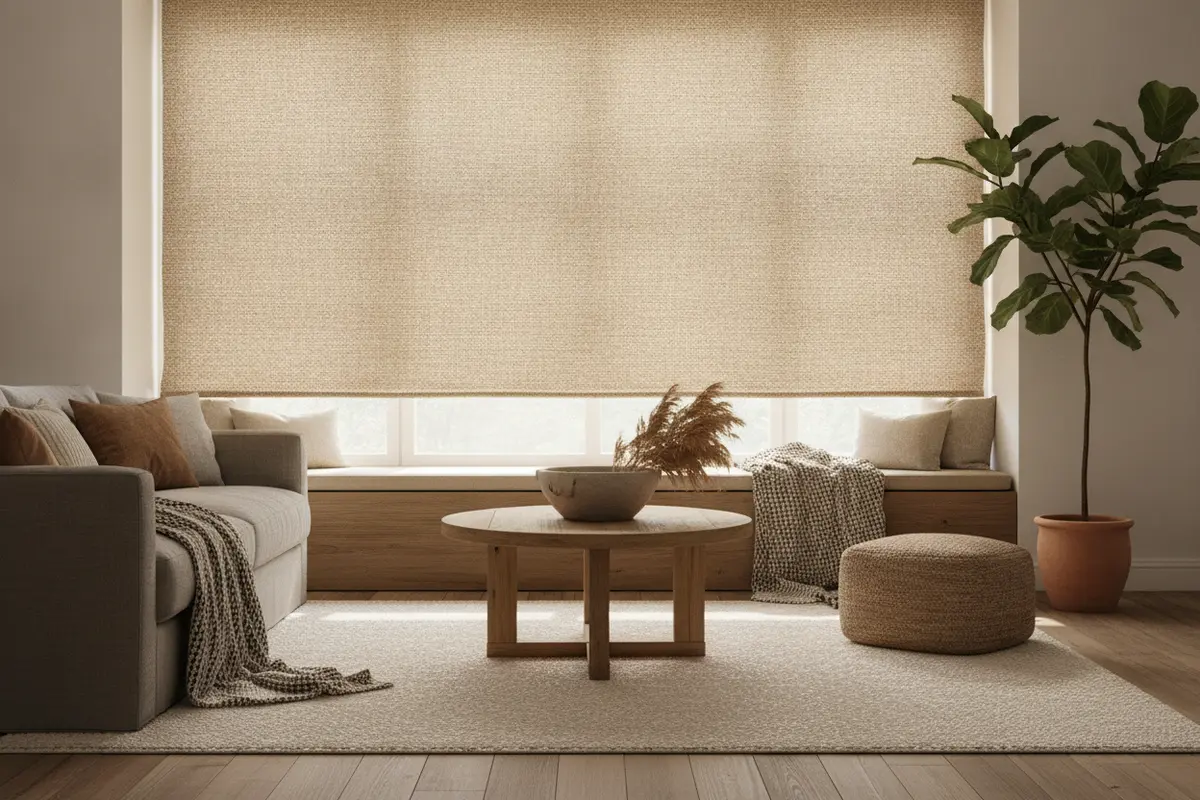
Woven shades are made from textured materials that may include grasses, reeds, bamboo, wood fibers, or other plant-based-looking materials. The weave gives them visual depth and a softer, more natural appearance than a flat roller shade. A blackout result usually comes from a liner or backing rather than from the front weave alone.
That distinction matters. An open weave can allow filtered daylight through. A blackout liner reduces light passing through the fabric, but light may still appear around the sides, top, or bottom if the shade is mounted inside the window opening. No fabric treatment can make an imperfect opening behave like a sealed wall.
Q: Do woven shades themselves block all light? A: Usually not. The blackout effect depends on the shade construction, liner, mounting position, and gaps around the window. Ask to see the front fabric and the lining as separate parts of the proposed product.
How much light control can you expect?
Think of light control as a range instead of a yes-or-no label. Your result can vary by fabric color, weave density, liner, window depth, and installation. A darker room may require both an opaque backing and a mount that limits side gaps.
- Filtered light: The weave softens direct daylight while preserving some brightness and texture.
- Room-darkening: A more substantial liner reduces light for bedrooms, media rooms, and presentation spaces, but edges may still glow.
- Blackout: An opaque liner and careful installation provide the strongest practical reduction in visible light, though small perimeter gaps can remain.
Product specifications should describe the intended light-control level rather than promising that every room will become completely dark. A government window-shade specification, for example, distinguishes woven shade fabrics and blackout series as separate product characteristics, which is a useful reminder to review the actual construction instead of relying only on a style name.
This public roller-window-shade specification references woven, stain- and fade-resistant fabric and a blackout series. It is a commercial specification, not a guarantee for every residential product, so use it as an example of the details that should appear in a quote.
Where do woven blackout shades work best?
Woven blackout shades can suit spaces where appearance matters as much as light control. The natural texture works well with wood floors, neutral paint, coastal interiors, and rooms that need a warmer finish than a plain fabric shade provides.
| Room or setting | Why consider woven blackout shades? | Details to confirm |
|---|---|---|
| Bedroom | Reduces early-morning light and adds privacy. | Blackout liner, side gaps, and the operating position. |
| Living room | Adds texture while limiting glare during bright hours. | Whether the view, color, or strongest light control is the priority. |
| Media room | Can support a darker viewing environment. | Perimeter light leakage and whether another shade type is more opaque. |
| Home office | Helps manage distracting brightness on screens. | Glare at different times of day and the window’s direction. |
| Business or meeting room | Creates a finished, coordinated appearance. | Consistent widths, operating needs, and any presentation equipment. |
Woven material is not automatically the best fit for every wet or high-use area. In a kitchen, bathroom, or other location with moisture, ask how the specific material and liner should be maintained. A sample viewed in the room is more useful than a product name alone because indoor lighting changes how the texture and color appear.
How do woven shades compare with other blackout treatments?
Comparison is easier when you separate appearance, light control, maintenance, and operation. Woven blackout shades emphasize texture. Other treatments may offer a cleaner surface, tighter edge control, or a different level of insulation, depending on their construction.
| Option | Appearance | Light-control considerations | Good question to ask |
|---|---|---|---|
| Woven shade with blackout liner | Natural, layered, and textured. | Liner helps reduce light; edges and mounting still matter. | How will the liner and side gaps be handled? |
| Blackout roller shade | Smooth and simple. | Can provide a clean opaque surface; perimeter gaps depend on the system. | Would an outside mount improve coverage? |
| Cellular shade with blackout fabric | Soft, pleated, and structured. | May combine light control with a cellular design, but construction varies. | What is the exact fabric and light-control rating? |
| Plantation shutter | Architectural and solid. | Adjustable louvers control light; closed louvers are not the same as a fabric blackout liner. | How much light enters between the louvers and frame? |
| Layered treatment | Combines textures or functions. | A second treatment can improve privacy or light control. | Will both treatments fit and operate comfortably? |
For a broader overview of products, see Vineyard’s guide to types of window coverings. If your priority is a smooth, minimal profile, compare the options on the custom shades page before choosing a woven front.
What should you consider before choosing the liner?
The liner changes both the performance and the appearance of a woven shade. Some liners are intended to reduce light while allowing the front texture to remain visible from inside the room. Others create a more opaque surface and can change how the shade looks from the street or from the back of the room.
Ask whether the liner is attached to the shade, positioned behind it, or supplied as a separate layer. A separate layer may offer more flexibility, but it can also affect the depth required inside the window. Check how the shade looks when raised as well as when lowered. The folded stack can be more visible with a liner, especially on a shallow window.
Color deserves a practical review, too. A light-colored woven front can brighten a room but may show the contrast of a dark liner differently than a darker front. Hold samples near the glass at several times of day. Review the room side and the exterior side if the windows face a street, walkway, or neighboring property.
Can a blackout liner reduce heat or glare?
A blackout liner is primarily a light-control feature. It should not be presented as an automatic promise of heat reduction or insulation. Glare may be reduced when direct light is blocked, but the thermal result depends on the full window assembly, exposure, glass, gaps, and documented product specifications.
Some solar shade materials are designed to filter sunlight, glare, and ultraviolet rays. A 2025 New York court opinion discussing solar roller shades describes those functions in the context of an engineered fabric product. That description does not establish that a woven blackout shade will deliver the same performance. Ask for specifications for the exact shade being quoted.
For a south- or west-facing window, discuss the time of day when glare is most difficult. A shade that looks effective in the morning may need a different mount or layering plan in late afternoon. The goal is to match the treatment to the problem, not to assume that the word “blackout” answers every comfort question.
How should you plan control and daily operation?
The right control makes a custom shade easier to live with. For a small, easily reached window, a manual control may be straightforward. Tall windows, wide openings, and frequently adjusted shades may call for a different operating method. Think about who will use the shade, how often it will move, and whether furniture or a nearby door limits access.
- Reach: Make sure the control can be reached without leaning over furniture or standing in a doorway.
- Clearance: Check that handles, cranks, doors, and adjacent shades do not interfere with movement.
- Grouping: Decide whether several windows should move together or independently.
- Noise and routine: Consider bedrooms, meeting rooms, and other areas where quiet operation matters.
- Safety: Ask about the available operating design for rooms used by children.
A U.S. Consumer Product Safety Commission report on window-covering manufacturing discusses cordless Roman shade products and the differences between corded and cordless construction. Review the report here, then ask the installer to explain the exact control system being quoted rather than assuming that every woven shade uses the same design.
How should you measure for woven blackout shades?
Accurate measurements affect both appearance and performance. An inside mount uses the window opening and can preserve trim visibility. An outside mount covers more of the surrounding area and may help reduce visible edge light, but it needs enough wall or trim space.
- Identify the mounting position. Check the depth, trim, handles, and nearby obstacles before deciding between inside and outside mount.
- Measure the opening carefully. Record width at the top, middle, and bottom, then record height at the left, center, and right. Do not assume the opening is perfectly square.
- Note operating clearance. Include window cranks, doors, furniture, thermostats, and adjacent shades that may interfere with the stack or controls.
- Check the whole grouping. Several windows may need coordinated headrail heights, fabric direction, or a split configuration.
- Review the final measurement. A professional measurement can catch depth and clearance issues before the order is placed.
Measurements are only one part of the order. Bring photos of the room, note the times when light is a problem, and identify whether privacy is needed during the day, at night, or both. A mobile consultation lets you compare samples in the actual space rather than judging texture under showroom lighting alone. Vineyard’s mobile window treatment service is built around bringing samples and measuring help to the customer.
What maintenance does woven material require?
Woven shades need a cleaning plan that fits the material and liner. Textured surfaces can collect dust in the weave, while moisture or aggressive cleaning may affect the finish. Before ordering, ask whether the shade should be dusted, gently vacuumed with an appropriate attachment, or cleaned in another way. Follow the product-specific guidance instead of applying a wet cleaner by default.
Keep the shade fully supported while cleaning and avoid pulling on individual fibers or edges. If a shade is installed near a sink, stove, shower, or frequently opened door, discuss the exposure before selecting the material. A sample can help you see the texture, but the installer or manufacturer should explain how that exact construction is expected to perform in the room.
Daily care also includes the hardware. Operate the shade smoothly rather than forcing it past an obstruction. Watch for a headrail that shifts, a liner that catches, or fabric that no longer hangs evenly. Addressing a small operating issue early is easier than continuing to pull against a misaligned treatment.
What should you ask before ordering?
A clear quote should identify more than the front fabric. Ask for the shade style, liner, color, dimensions, mount, control, and expected installation details. These questions help prevent a beautiful sample from becoming a disappointing finished result.
- Is the quoted shade filtered light, room-darkening, or blackout?
- Is the liner attached, removable, or a separate layer?
- What amount of light leakage should be expected at the sides and bottom?
- Would an outside mount or a layered treatment better suit this window?
- How will the texture and color look in direct sun and evening light?
- What cleaning method is appropriate for the specific woven material?
- Will each shade operate by chain, cordless control, or motorization?
- Are measuring and professional installation included in the proposal?
Safety and daily use deserve attention too. For rooms used by children, ask about the available operating design and how controls should be positioned. For tall windows or frequently used doors, consider whether a motorized or easier-to-reach option would make the treatment more practical. The best woven shade is one that looks right and gets used correctly every day.
How does professional installation affect the result?
Installation affects alignment, clearance, operation, and the final appearance of a woven shade. A small measurement error can be visible across a wide window. An uneven headrail can make matching shades look inconsistent, while a control placed too close to a handle can make the shade inconvenient to use.
Before installation, confirm which windows are included, where the brackets will go, whether trim must be avoided, and how the shades should be tested. After installation, operate each shade fully. Check that the fabric hangs evenly, the liner moves as intended, and the control does not collide with nearby hardware.
Vineyard positions its service around in-home window treatment help, including free measuring and free installation. Those approved services can simplify the process, but the product selection and quoted specifications should still be reviewed before approval.
Call Vineyard Blind & Shutter at (951) 757-4188 to arrange your next window treatment conversation.


