
Choosing Polycore shutters in Winchester means weighing more than appearance. Material, louver size, frame, window shape, and how the room is used all affect the result. This local guide explains what to consider before ordering, how to prepare for measurement and installation, and how Polycore compares with other window-covering options.
Call Vineyard Blind & Shutter at (951) 757-4188 to discuss your window project.
Why consider Polycore shutters for a Winchester home?
Polycore is a composite shutter material. Homeowners often compare it with natural wood and other window coverings because they want a substantial shutter look with a surface suited to everyday household conditions. The right choice still depends on the actual product construction, the window, and the room. Ask what the specific shutter is made of and what care its manufacturer recommends rather than assuming every composite product performs the same way.
Winchester homes can have different window exposures and interior conditions from room to room. A sunny front room, a busy kitchen, and a bedroom that needs privacy do not necessarily need identical shutters. Start with the purpose of each window: how much daylight you want, how much of the view you want to preserve, and how often you expect to adjust the louvers.
Polycore shutters may be worth considering if you prefer the defined lines of plantation-style louvers and want a permanent, fitted treatment. They are not automatically the best choice for every opening. A careful review of window size, hardware clearance, room use, color, and cost makes the decision more practical. You can also browse the company’s overview of Polycore shutters for a broader introduction.
Q: What is the first question to answer? A: Decide what the window needs to do. Privacy, adjustable daylight, a finished architectural look, and ease of daily operation may matter in different proportions from one room to another.
How should you think about moisture resistance and durability?
Composite materials are often considered for rooms where household moisture may be a concern. That does not mean a shutter is waterproof, suitable for direct water exposure, or immune to damage. Construction, finish, installation, ventilation, and maintenance all matter. Confirm the product’s specific limitations with the supplier, especially near sinks, tubs, or other places where splashing and condensation are likely.
For a kitchen, consider whether the window is close to cooking activity, a sink, or a regularly opened door. For a bathroom, assess ventilation and how much moisture reaches the window area. Keep shutters clear of standing water, wipe off splashes promptly, and follow the manufacturer’s cleaning instructions. Avoid using harsh cleaners or abrasive pads unless the product care guide specifically allows them.
Durability also depends on how shutters are used. Louvers that are forced beyond their normal range, panels that are swung into furniture, or hinges that are left loose can wear prematurely. Teach household members how to open the panels and tilt the louvers without pulling on a single slat. If a panel starts to drag or a louver no longer moves smoothly, address the issue before it worsens.
Do not judge durability only by a material name or a photograph. Ask about the product’s construction, finish, panel and louver options, cleaning guidance, and warranty terms. Check whether the window frame is in good condition and whether the installation plan accounts for any irregularities. A correctly specified and fitted product is more likely to operate as intended than one chosen from appearance alone.
For general information about indoor environments and moisture, you can consult the U.S. Environmental Protection Agency. Product-specific questions about a shutter’s moisture limits should still be answered by the manufacturer or installer.
Which rooms and window conditions are a good fit?
Polycore shutters can be considered in living rooms, bedrooms, dining areas, and other spaces where their panel-and-louver format suits the window. Their solid frame gives the opening a defined border, while tilting louvers lets you adjust incoming light and the view. Consider how the panels will swing and whether furniture, handles, window cranks, or nearby walls could interfere.
In a bedroom, think about privacy at night as well as daytime light. Louvers can be tilted, but they are not the same as a sealed blackout covering. If you need very low light for sleep, discuss whether another layer is appropriate for your needs. In a living room, consider the direction of the view and whether you want light to enter while reducing direct sightlines from outside.
For a kitchen or bath, focus on proximity to water, ventilation, cleaning access, and product care limits. For a room with children or pets, consider how the panels will be reached and operated, along with any manufacturer guidance about safe use. For unusually shaped or tall windows, ask whether the opening can be covered with the proposed panel layout and whether a different treatment would operate more conveniently.
A room-by-room plan helps prevent a single choice from being forced onto every window. Note which windows need more privacy, which receive strong sun, and which are opened frequently. Vineyard’s comparison of window-covering types can help you think through shutters, blinds, and shades before deciding that one style belongs throughout the home.
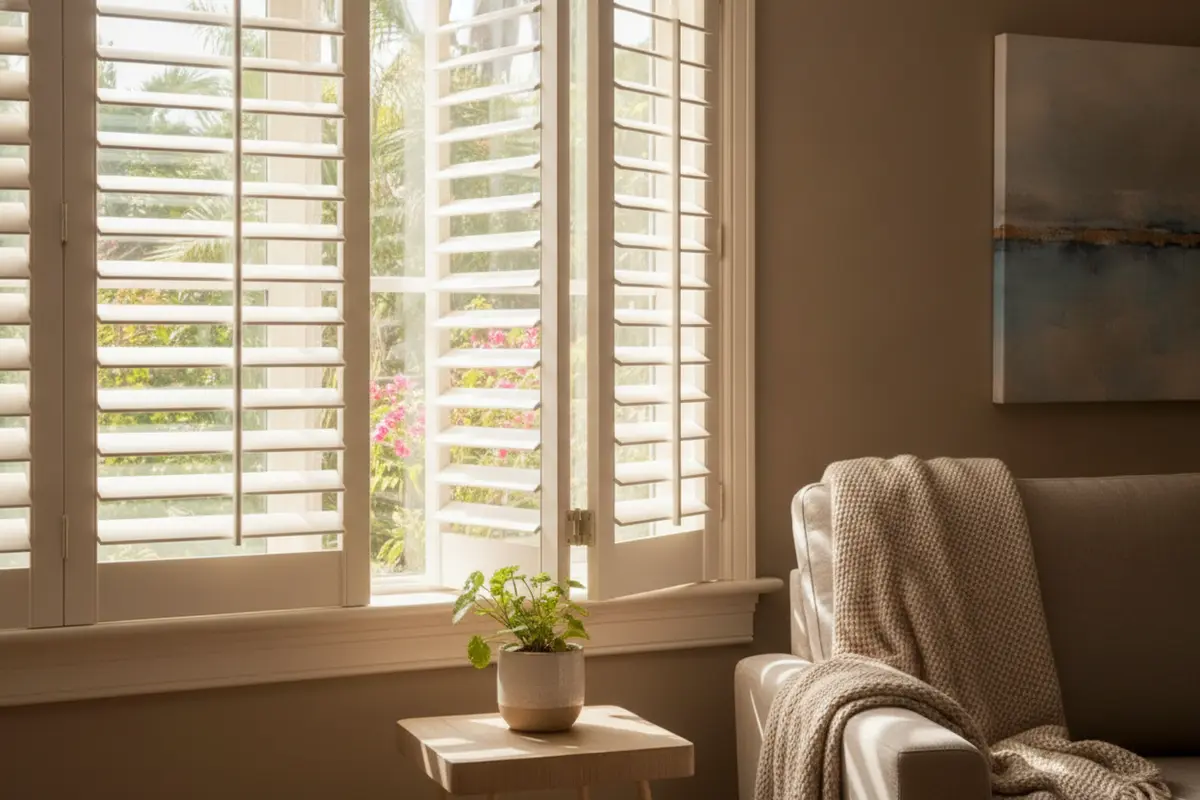
How do color, louvers, and panel layout affect the look?
Color has a major effect on whether shutters blend into the room or become a feature. A white or light neutral can coordinate with pale trim and make the window feel visually open. A deeper tone can create contrast, but it should work with the flooring, cabinetry, wall color, and other fixed finishes. Compare samples in the room where the shutters will be installed. Colors can look different under warm evening lamps than in daylight.
Think about louver width in relation to the window and the look you want. Wider louvers show more of the view when open and create a bolder horizontal pattern. Narrower louvers make a finer pattern and may suit a smaller opening or a more traditional preference. The best choice is not universal; it depends on the scale of the window, the panel design, and what feels balanced in the room.
Next, consider how many panels the window needs and where they will meet. A wide opening might call for several panels rather than one oversized panel. The number and direction of panels affect the view, access to the window, and the way the shutters fold or swing. Ask how the proposed layout will work with any center mullions, locks, handles, or nearby furniture.
Frame and mount details also influence the finished appearance. An inside mount sits within the opening when the window depth and shape allow it. An outside mount covers the opening and may be considered when the inside frame is shallow or irregular. Neither is automatically preferable; the measurement and trim conditions determine what can work. Review the frame profile and how it will meet the existing casing before approving a layout.
How can you evaluate a sample in the actual room?
A product sample is more useful when you assess it in context. Hold the sample beside the window trim, then look at it from the doorway and from the main seating area. A finish that looks right close up may read differently across the room. If you are considering several rooms, view the same finish near each opening, since wall color and natural light can change how it appears.
Try to compare samples at more than one time of day. Notice how the finish looks in bright daylight and in the artificial lighting you use in the evening. This is especially helpful when the shutters will sit near painted cabinetry, wood flooring, or other large surfaces. Compare undertones as well as lightness: a neutral sample can appear warmer or cooler next to the room’s existing finishes.
Look beyond color. Consider whether the louver width feels proportional to the window, whether the frame profile suits the trim, and whether the sample gives you the visual weight you want. Think about what you see when the louvers are open and closed. If possible, ask to see a larger sample or a completed example of the same product. A small swatch may not show the full effect of a panel layout.
Then test the practical questions. Imagine opening the panels to reach the window, cleaning the glass, or moving furniture nearby. Check whether the treatment could cover a handle or make a lock difficult to access. If you want a consistent look throughout connected spaces, compare the proposed finishes together rather than choosing each in isolation. You can still vary the treatment by room when function calls for it, while coordinating the colors and frame details.
Keep notes as you compare. Record the room, sample finish, louver size, panel plan, and any unresolved product question. This makes it easier to revisit a decision after the home visit and reduces the chance of remembering only a general impression. The goal is not to rush toward one style, but to determine whether the specific sample and configuration fit both the room and the way you use it.
What should you compare before choosing Polycore over another treatment?
Compare each option against the needs of the specific room, not just the product’s initial appearance. The table below is a planning aid, not a promise that every product in a category has identical features. Materials, available configurations, and installation details vary. Ask for the exact product specifications and a quote based on your own window measurements.
| Option | What it can suit | Points to review |
|---|---|---|
| Polycore shutters | A fitted, structured look with adjustable louvers and panels | Material details, moisture limits, panel swing, louver and color choices, and custom fit |
| Wood shutters | Homeowners who value a natural wood appearance | Room conditions, finish and care, window size, and total project cost |
| Faux wood or other blinds | Windows where a simpler slatted treatment is preferred | Slat size, headrail and operating method, cleaning, and how the treatment fits the trim |
| Shades | A softer profile or a continuous fabric surface | Desired light control, privacy, fabric and operation options, and whether a second layer is needed |
When comparing quotes, make sure you are comparing similar scope. Check how many windows are included, what material and finish are specified, whether the panels and frames are custom sized, and what measuring and installation involve. Ask whether unusual shapes, trim conditions, or hardware require a different configuration. A lower initial number may not represent the same product or work as a more complete proposal.
Price varies with window dimensions, product selection, quantity, and installation details. Treat a general online price as a starting point rather than a quote for your home. Vineyard’s Polycore shutter price guide offers a place to explore cost considerations. For a wider comparison of options, see the company’s custom shutter information and custom shades information.
How can you prepare for measuring and installation?
Before measurement, make a simple list of the windows you want to cover and the reason for treating each one. Note any window that is unusually wide, tall, angled, or obstructed. Include nearby handles, locks, window cranks, alarm sensors, and furniture. Photos can help you remember details, but they do not replace a professional measurement for a custom order.
- Decide which rooms and windows are part of the project, and identify any future phase separately.
- Write down the main goal for each opening, such as privacy, adjustable daylight, or a consistent room finish.
- Note any water exposure, condensation, direct sun, or ventilation concerns near the window.
- Check how panels could swing without hitting furniture, doors, lamps, or window hardware.
- Gather samples of nearby paint, trim, or cabinet colors to compare against shutter finishes.
- List questions about product care, warranty terms, material construction, and the installation sequence.
During a home visit, view samples close to the actual window and in the room’s light. Ask the measurer to explain how the frame and panels will fit, especially if the opening is out of square or the trim is not uniform. Confirm the louver direction, panel count, hinge placement, and access to window locks before the order is finalized.
Vineyard’s mobile window-treatment service brings samples and measuring to the home. Free measurements and free installation are part of the company’s stated service positioning. Confirm the details for your specific project and product before proceeding. To learn more about service coverage, review the areas Vineyard serves; Winchester is in Riverside County.
Before installation day, clear access to the windows and move breakable items away from the work area. Ask what needs to be moved and whether the installer expects the rooms to be ready in a particular way. After the shutters are fitted, operate each panel and louver while the installer is present. Confirm that panels close, latches align, and the treatment does not conflict with the window’s hardware.
How should you judge long-term value?
Value is a combination of fit, daily usefulness, appearance, product life, and total price. A shutter can be a poor value if the panel layout makes the window awkward to use, even when the material seems attractive. Conversely, a well-planned treatment may earn its place if it meets your privacy and light-control needs and looks right with the room.
Think about how long you expect to stay in the home and how consistently the shutters work across the rooms you use most. If the project covers several windows, you might prioritize high-use rooms first and add other spaces later. Ask whether the appearance and available finishes will coordinate across phases, and keep the chosen product details so future additions can be compared appropriately.
Do not base a decision on an unsupported promise about energy savings, noise reduction, or maintenance-free performance. If one of those outcomes matters to you, request product-specific information that explains what the selected shutter can and cannot do. Also compare the practical upkeep: how to dust the louvers, how to clean the finish, and what to do if a hinge or operating part needs attention.
Make your final comparison with the same checklist for each proposal: exact material and finish, measurements, frame and panel layout, installation scope, care instructions, warranty terms, and total project price. If an answer is unclear, ask for it in writing before placing an order. That makes it easier to compare the actual options rather than relying on a broad label such as “composite shutter.”
What questions should Winchester homeowners ask?
Bring specific questions to a product discussion, and ask for clear answers tied to the actual window and shutter being considered.
- What is the precise material and construction of this Polycore product?
- What are its moisture limits, and what care is recommended for a kitchen or bathroom?
- Which louver widths, finishes, frame profiles, and panel layouts are available for my windows?
- Will the panels clear my handles, trim, furniture, and window opening?
- What exactly is included in measuring, installation, and the written quote?
- What warranty applies, and what kinds of damage or wear are excluded?
Good answers should be specific rather than a blanket assurance. For instance, if a window is close to a sink, ask about that exact exposure rather than asking only whether composite shutters are “moisture resistant.” If a window is an unusual shape, ask how the proposed frame and panels will be built and operated. A clear explanation helps you decide whether the product matches the room.
With careful attention to material, room conditions, fit, and installation details, Winchester homeowners can decide whether Polycore shutters suit their home rather than relying on a product label alone.


