
Choosing stained wood shutters in Riverside County means balancing the look of real wood with the way each room is used. Grain, stain tone, sunlight, moisture, and window shape all affect the result. A useful decision starts with the room and the window, then compares finish and material choices rather than choosing a color from a small sample alone.
Call Vineyard Blind & Shutter at (951) 757-4188 to discuss stained wood shutters.
What makes stained wood shutters a good fit for a room?
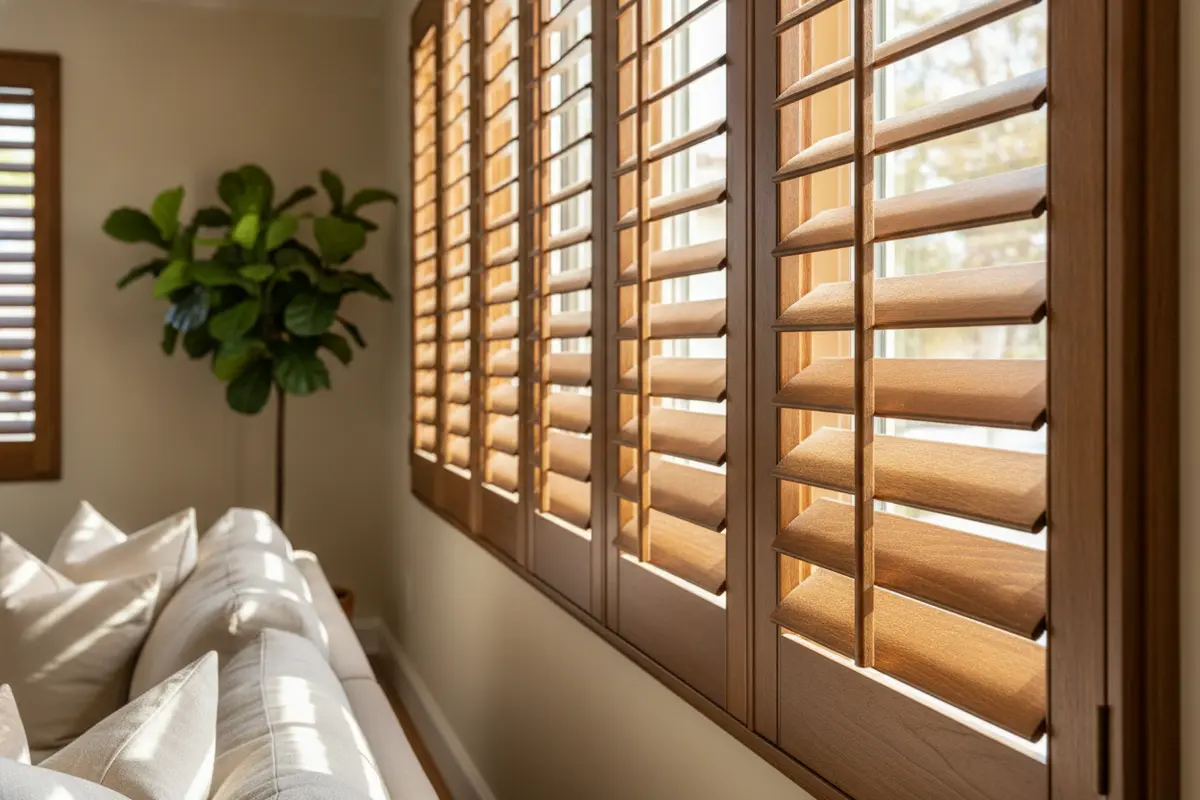
Stained wood shutters let the material's grain remain part of the design. Unlike an opaque painted surface, a stain can show variations in the wood while adding a chosen tone. That makes them a natural option when you want the window treatment to relate to wood floors, cabinetry, furniture, or trim without requiring every surface to match exactly.
Plantation-style louvers can be tilted to adjust daylight and the view, while the panels provide a defined architectural frame. The appearance can feel traditional or current depending on the louver width, panel layout, color, and surrounding decor. Consider the full window, not only the shutter sample: casing, sill depth, wall color, and the room's other finishes all influence how the stain reads.
Q: What is the main design advantage of a stain? A: It gives you color while keeping visible wood character, so the finish can coordinate with nearby materials without hiding the grain.
Wood is not automatically the right choice for every window. A room's moisture, direct sun, cleaning routine, and desired upkeep matter. The material should suit the environment and the way you expect to use the shutters. For a broader look at the available custom shutter options, compare the material and construction alongside the style.
How should you compare grain and stain color?
Start by deciding whether the shutters should blend in or stand out. A stain close to existing floors or trim can create a coordinated feel, while a deeper or lighter tone can make the window a focal point. Exact color matching can be difficult because wood grain, lighting, and the finish on nearby surfaces change the way colors appear.
- Look at the grain: Ask how visible the grain is in the wood and finish samples available for the project. Natural variation is part of the look, so a finished shutter may not appear perfectly uniform.
- Compare undertones: A brown stain may look warmer, cooler, redder, or more neutral beside your floor or cabinetry. Compare samples in the room rather than relying only on a screen or showroom lighting.
- Check the light at different times: Daylight shifts during the day, and lamps can change how a finish looks in the evening. View the sample by the actual window if possible.
- Think about contrast: A close match can feel quiet and cohesive. A distinct tone can frame the window. Neither approach is universally better; choose what suits the room's other colors and materials.
When reviewing a sample, view it vertically and at a normal distance as well as up close. Ask whether the sample represents the type of wood and finish being quoted. If the existing wood surfaces have aged, a new stain may coordinate without being identical. It is usually more useful to aim for a pleasing relationship in tone than to expect an exact match across different materials.
It can help to take a few reference photos of the room and bring them into the conversation, but photos should not replace viewing a sample in person. Phone cameras can shift color, and screens are not reliable color standards. If two stain options seem close, compare them against the main surfaces that will remain in the room, such as flooring and trim, then consider whether the shutters should recede into the background or frame the view.
How do sunlight and window direction affect the finish?
Strong sunlight can make a window feel bright and can change how a stain appears throughout the day. The direction and amount of light, the presence of nearby shade, and the interior's colors all influence what you see. If a window receives long periods of direct sun, ask how to care for the finish and whether the selected product has specific guidance for that exposure. Do not assume every finish will age in the same way.
Shutters provide adjustable light control through the louvers, but they do not make direct sunlight disappear in every position. Consider when glare is most noticeable and whether you want to preserve a view while reducing incoming light. Try to describe the daily issue plainly: morning glare on a screen, late-day brightness in a seating area, or a wish for more privacy at night. That helps you consider louver operation and panel layout rather than choosing by color alone.
If your main concern is managing brightness, compare shutters with other window coverings as well. A custom blinds option or a shade may suit a different light-control preference. The right comparison depends on the room's use, the desired view, and how you want to operate the covering.
What should Riverside County homeowners know about moisture?
Moisture deserves special attention before choosing a wood product. Bathrooms, kitchens, laundry spaces, and windows near frequent splashes or condensation can expose a treatment to conditions that differ from a dry bedroom or living room. Wood can respond to changes in moisture, so do not assume stained wood shutters are suitable for every damp or high-humidity location.
Describe the actual conditions at the window when asking about materials. Is it close to a sink or shower? Does condensation regularly collect on the glass? Is ventilation limited? Is there a history of water reaching the sill? Those details help distinguish occasional humidity from repeated direct exposure. Follow product-specific care and suitability guidance instead of relying on a general promise that a particular material will work in every room.
Wood responds to its surrounding environment, which is one reason the room and the product finish both deserve attention. The U.S. Forest Service's Forest Products Laboratory provides wood science and technology information; use product-specific guidance for the shutter you are considering rather than treating general wood information as a warranty or suitability ruling. Ask whether the maker has care recommendations for the finish and whether there are conditions under which it should not be installed. A clear answer is more useful than a broad claim that wood is unaffected by humidity.
Also distinguish a room that is merely humid at times from one where the window treatment is repeatedly exposed to water. A kitchen window away from the sink may have different demands from a bathroom window beside a shower. If you are not certain, describe the exposure and ask for a material recommendation before settling on a stain color. You can still coordinate the look across rooms while choosing different materials where conditions call for them.
Composite shutters are one alternative worth comparing where moisture is a concern. Their construction differs from natural wood, and the appropriate choice depends on the product and the room. Read about Polycore shutters as one option, then ask which material and finish are appropriate for the window's actual conditions. Do not treat the label “composite” as a guarantee of performance in every wet environment; confirm product details.
How do stained wood shutters compare with composite?
There is no single best material for every home. Wood may appeal when natural grain and a stained finish are central to the design. Composite alternatives may be worth discussing when the room's conditions or maintenance preferences change the priorities. Compare the product construction, finish choices, room suitability, care instructions, and overall quote rather than assuming one material always costs less or lasts longer.
| Consideration | Stained wood shutters | Composite shutters |
|---|---|---|
| Appearance | Visible natural grain and stain tones can be part of the design. | Appearance and finish depend on the specific product; natural wood grain may not be the defining feature. |
| Room conditions | Discuss moisture, condensation, and direct exposure before selecting. | May be an alternative to compare for some rooms; verify product-specific suitability. |
| Color choice | Stain lets grain show and can coordinate with other wood finishes. | Ask what colors and finish styles are offered for the specific model. |
| Care | Follow the finish's care directions and avoid assuming every cleaner is suitable. | Follow the manufacturer's instructions for the selected material and finish. |
| Price | Custom pricing depends on window dimensions, layout, finish, and product details. | Custom pricing also depends on dimensions, construction, and configuration; compare itemized quotes. |
A fair comparison keeps the scope consistent. If one quote includes different panel layouts, louver sizes, or installation details, the total alone does not show which is the better fit. Ask what product is specified, how the shutter will mount, what finish is included, and which services are part of the project. Vineyard Blind & Shutter provides free measurements and free installation; confirm how those apply to the specific order.
What measurements and window details matter?
Custom shutters are made for a particular opening, so accurate measurements and an appropriate mount are important. An inside mount sits within the window opening, while an outside mount covers the opening from the surrounding wall or trim. The best arrangement depends on depth, casing, handles, sill shape, and the look you want. Do not assume every opening has enough depth for an inside mount.
Before an in-home measurement, make a list of the windows and note any details that could affect operation. Include windows that are unusually wide or tall, have angled or arched tops, sit near furniture, or have cranks and handles. Take photos from inside the room and note whether a window is used as an exit or opened regularly. These details can help the discussion focus on practical use as well as appearance.
Consider panel division and louver operation with the window's proportions. More than one panel may be appropriate for a wider opening, but the layout affects where the vertical divisions fall. Think about which panels you want to open, whether you need access to the sill, and how frequently you adjust the louvers. For an overview of different styles and configurations, explore types of window shutters.
How can you plan for care and long-term value?
Care starts with the specific finish and product instructions. Ask how to remove routine dust, what cloth or cleaning method is recommended, and which products should be avoided. Keep cleaning gentle unless the manufacturer's guidance says otherwise. Wiping with excess liquid or applying an unapproved cleaner can be a poor choice for a wood finish.
Make a simple maintenance routine that fits your household. Dust the louvers and frame as needed, and clean promptly if a spill or splash reaches the shutter. Check that panels and louvers move as expected. If operation changes or you notice damage, consult the product or installer guidance rather than forcing a component. Care needs vary with the room, household activity, and finish, so avoid treating a single schedule as right for all windows.
Long-term value is not just the initial price. Consider the look you want to live with, how the shutters operate, whether the material suits the room, what care it requires, and how the quote describes measurement and installation. A higher or lower quote cannot be judged fairly without comparing the included product and scope. Ask for clarification on any line you cannot connect to a specific feature or service.
What should you review before ordering?
Use a short checklist so that finish decisions do not overshadow the practical details. Review each room separately; a whole-home order can include different conditions and priorities from one window to the next.
- Describe the room: Note its use, privacy needs, light conditions, and any recurring moisture or condensation.
- Choose the design direction: Decide whether the stain should blend with nearby finishes or provide contrast, and review grain samples in the room's light.
- Confirm the window details: Discuss depth, casing, handles, opening direction, and any unusual shapes or dimensions.
- Compare materials: Review wood and composite options against the room's conditions, desired appearance, and care expectations.
- Review operation: Discuss panel count, louver movement, and access to windows or sills.
- Read the quote: Confirm the specified product, finish, layout, measurement, installation, and any other included work.
- Ask about care: Get instructions for the exact material and finish before cleaning or treating the shutters.
If you are comparing projects across a home, group the windows by room and condition. That makes it easier to see where a stained wood finish is a design priority and where another material might be more practical. It also prevents an assumption made for a dry living room from automatically being applied to a bathroom or kitchen window.
How can Riverside County homeowners explore custom options?
Vineyard Blind & Shutter brings product samples and measuring services to customers' homes through its mobile service model. Seeing a stain beside your flooring, cabinetry, and wall color can be more informative than viewing a small sample in isolation. A measurement visit can also help identify mounting or operating details that are easy to overlook when looking at a photograph.
When you plan a project, share the rooms you are considering and the questions you want answered: grain and finish, room conditions, panel layout, and the wood-versus-composite comparison. Vineyard serves Riverside County as well as San Diego and Orange counties. Review the service area information if you want to confirm coverage, or explore dark wood plantation shutter ideas for another view of darker stained finishes.
The most satisfying choice is one that fits both the design and the conditions of each window. Compare samples in the room, ask clear questions about material and care, and confirm the custom details before placing an order.
Call Vineyard Blind & Shutter at (951) 757-4188 to discuss your window and finish choices.


