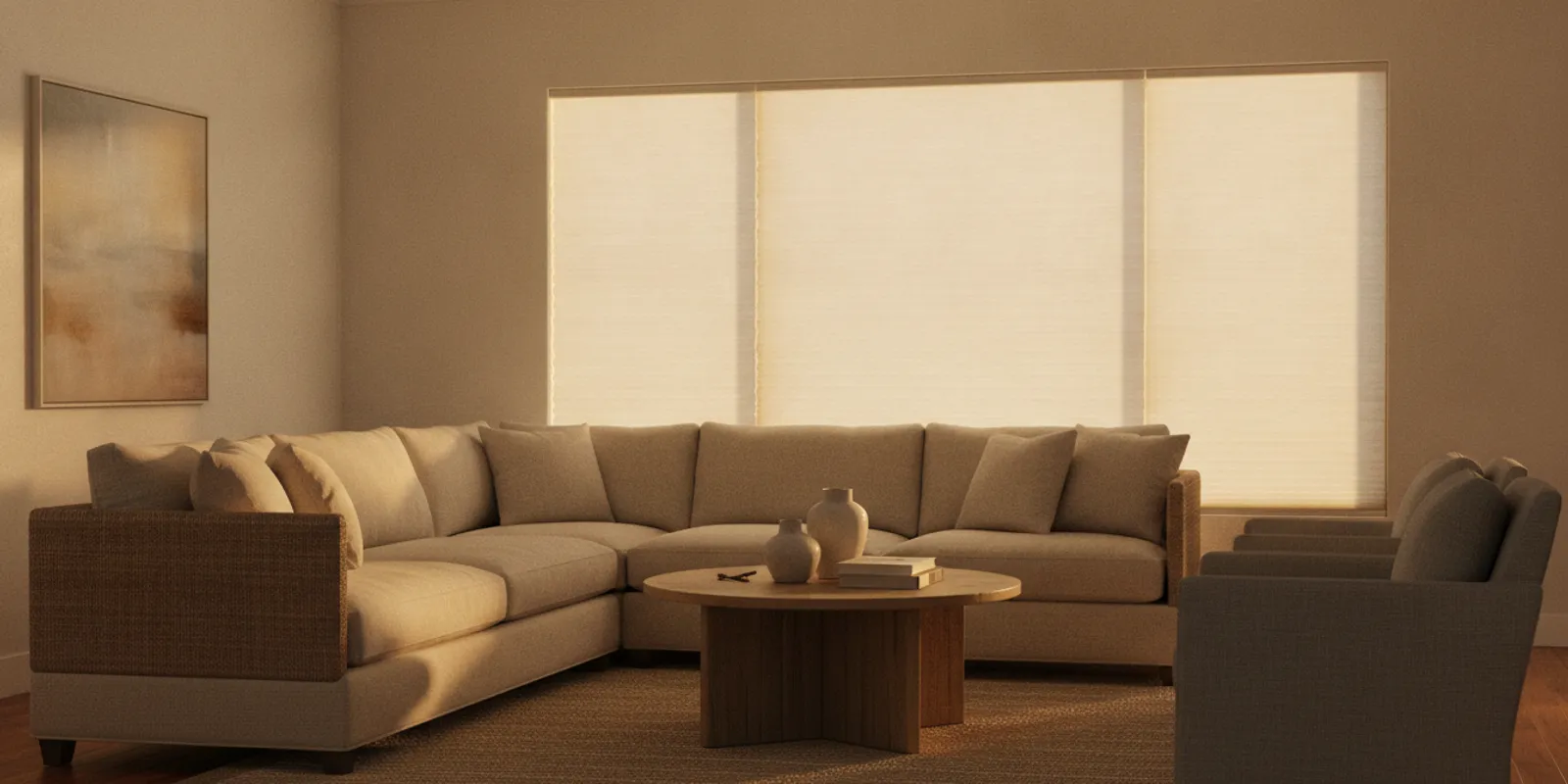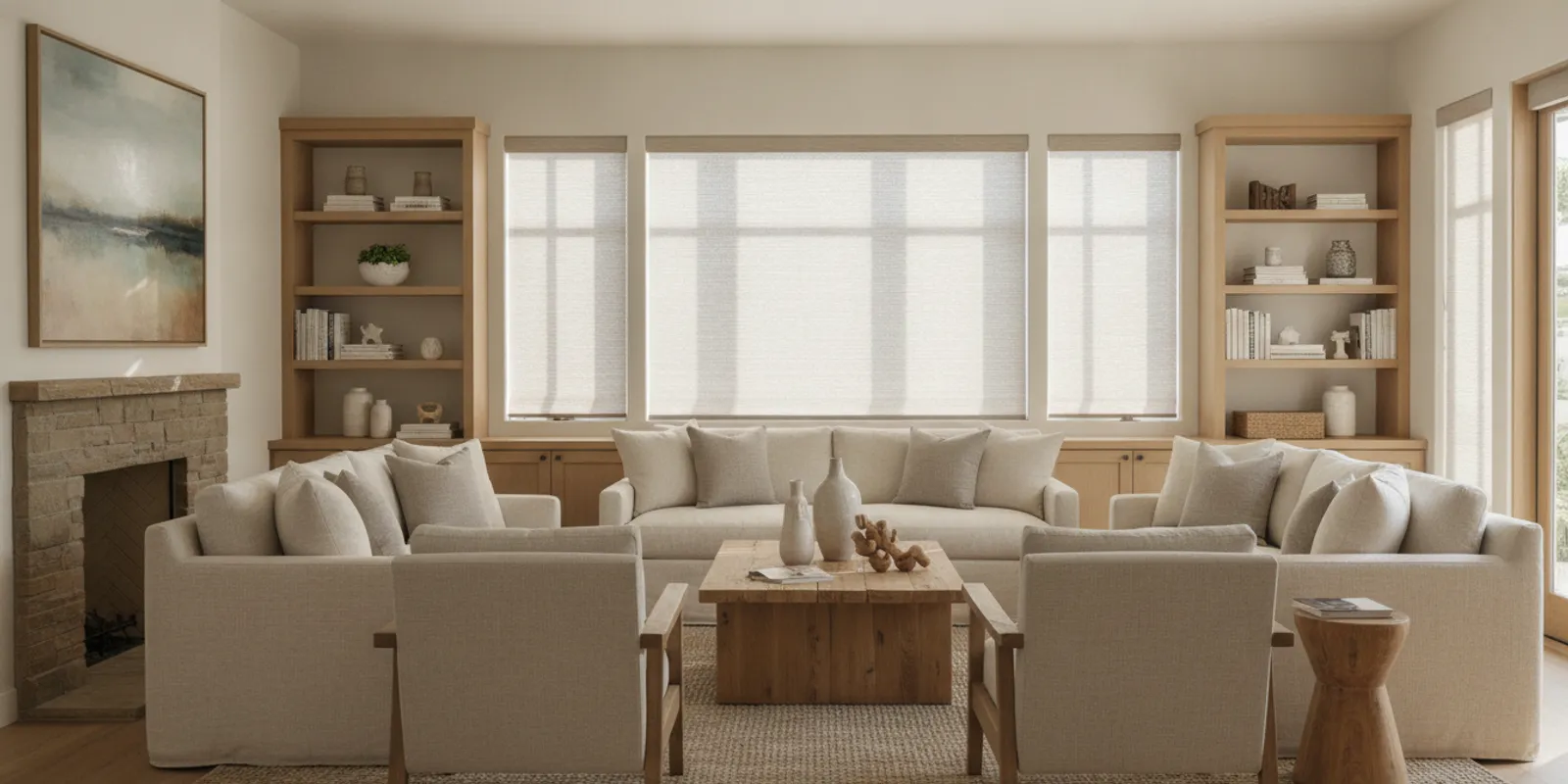
Choosing window treatment ideas for living room windows starts with how you use the space. You may want to soften afternoon sun, manage television glare, preserve a view, or add privacy after dark. The right option balances those priorities with the window shape, furniture, and how you want the room to look.
Request a discussion about your living room windows.
Call Vineyard Blind & Shutter at (951) 757-4188 to talk about your project.
Q: What is the best living room window treatment? A: There is no single best choice for every room. Blinds and shutters use adjustable slats or louvers, while shades move as a continuous panel. Compare light control, privacy, operation, and appearance in the room before choosing.
What should living room window treatments do?
Begin with the room’s main job. A living room used for reading may need comfortable daylight across a chair or sofa. A room where the television is often on may need a way to reduce glare at certain hours. If windows face a walkway or neighboring homes, privacy at night may matter more than keeping an unobstructed view all evening. Write down your two or three highest priorities before comparing product styles.
- Light: Should daylight remain adjustable, be filtered, or be reduced when the covering is closed?
- Privacy: Can someone see inside from outside, especially after dark when room lights are on?
- View: Should the treatment uncover most of the glass when raised or drawn aside?
- Operation: How often will you adjust it, and are the controls easy to reach?
- Appearance: Should the covering blend with the wall or become a feature?
- Care: How much time do you want to spend dusting or following fabric-care directions?
Describe priorities as outcomes rather than product names. For example, keeping daylight while making the television easier to see leaves room to compare different products that may address glare. Check the room at more than one time of day. Morning and afternoon sun can enter at different angles, and an evening view from outdoors may reveal privacy concerns that are not obvious in daylight. Note seating and screen positions, too; a sofa may block controls or a door may swing into panels.
Which options balance light and privacy?
Blinds and shutters use slats or louvers that can be angled. You can redirect some daylight and adjust sightlines without moving the entire covering. Shades use a continuous panel, so the material and how far it is lowered shape light and privacy. These are broad categories; details vary by product and configuration. Compare the specific construction and sample rather than assuming every product in one category behaves the same way.
| Option | How you adjust light | Privacy to review | Useful starting point |
|---|---|---|---|
| Faux-wood blinds | Angle slats or raise the blind | Check slat closure and small gaps | Familiar horizontal lines and adjustable control |
| Vertical blinds | Rotate vanes or draw them to one side | Review coverage across the full opening | Wide windows where side-drawing operation suits the room |
| Shades | Choose fabric and raise or lower the panel | Opacity and edge coverage depend on the product | A continuous surface or softer fabric look |
| Plantation shutters | Angle louvers and open panels as configured | Closed louvers cover the window; edges may admit light | A defined frame with adjustable louvers |
Terms such as light filtering and room darkening describe a light-control function, not a promise that every ray will be blocked. Light may enter around edges, and results depend on fit, material, and installation. Do not assume a darker room means a specific reduction in heat. If thermal performance matters, ask for documented specifications for the product being considered. Compare what happens when each treatment is fully open, how much glass remains covered, and whether you can adjust privacy without losing all daylight.
How do you match a style to the room?
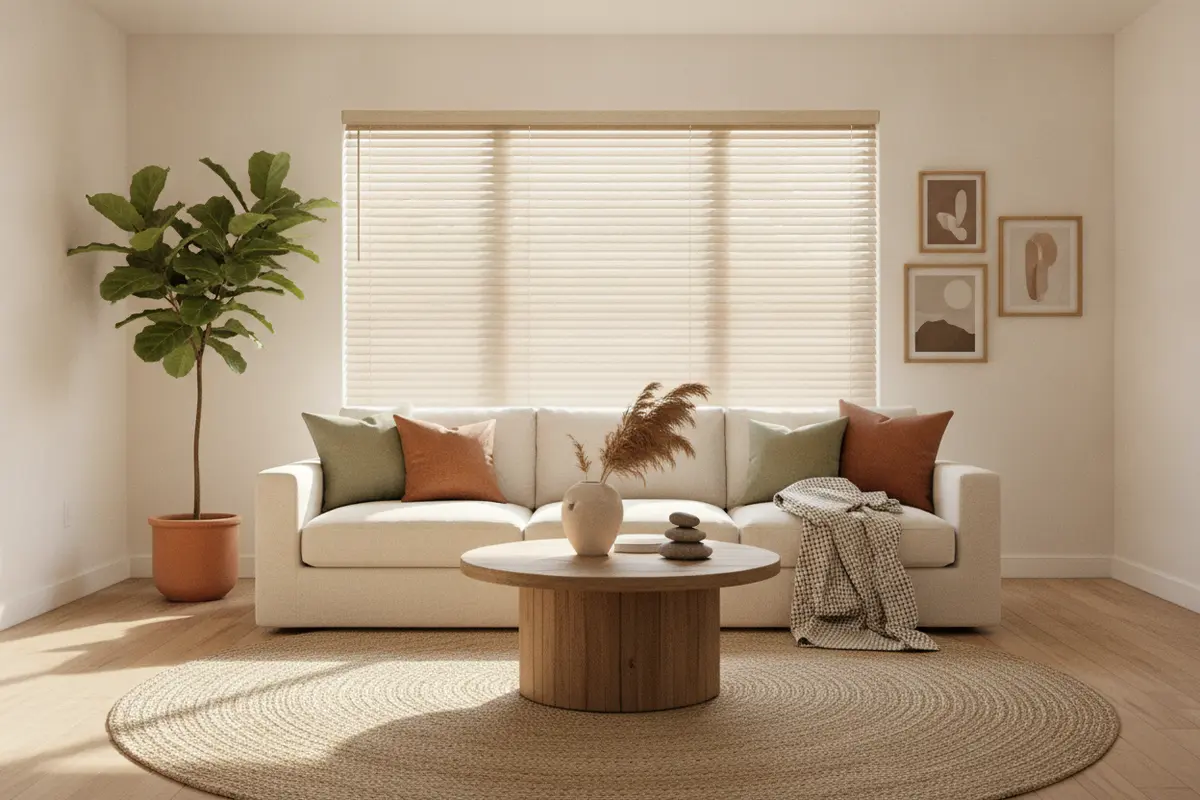
Look at the shapes and materials already in the room. Horizontal slats can echo a wide, low window or other horizontal lines. Vertical vanes can reinforce a tall opening. Fabric shades may soften a room with hard surfaces, while shutters create a defined frame around glass. These are visual cues rather than fixed rules. A sample against your own wall and furniture is a better guide than a small product image or a screen.
Color helps determine whether a treatment recedes or stands out. A shade close to the wall color can make a window feel quieter. A contrasting finish can draw attention to it. Compare the covering with nearby flooring, trim, upholstery, and artwork. If the room has a bold rug or patterned sofa, a simpler treatment may help balance the view. If furnishings are restrained, a covering can add texture or an accent. Consider how the chosen color looks in daylight and with lamps on after dark.
Think about the open position as well as the closed one. A shade may gather at the top; vertical vanes draw to one side; shutters remain as panels around the glass. If the view is a major feature, consider where the stack or panels will sit. For several windows, coordinated colors can create continuity while different operating styles address different exposures or shapes. For broader room planning, compare window covering product categories and browse the window treatment gallery for finished-room examples.
What should you measure and check before choosing?
The window opening and nearby space affect fit and operation. An inside mount sits within the frame; an outside mount extends over some surrounding area. Which approach works depends on frame depth and shape, trim, hardware, obstacles, and the result you want. Avoid making a final decision from a quick glance at the window. Record width and height at several points because openings may not be perfectly square, and note handles, locks, cranks, and other hardware.
- Record width and height at several points.
- Note frame depth, trim, handles, locks, cranks, and other hardware.
- Check nearby furniture, radiators, doors, and walkways for interference.
- Decide whether coverage should sit within the frame or extend beyond it.
- Consider how the window opens and whether you need access for ventilation or cleaning.
- Review control placement and safe operation, especially in a room used by children or pets.
These checks can reveal tradeoffs early. A deep sill may provide room for an inside mount, while projecting handles may require extra clearance. A sofa close to a window might make a side-drawing treatment less convenient. A window used regularly may need a design that leaves operating hardware accessible. Have a qualified installer assess details that are not clear from your measurements, including unusual frames or obstacles that could affect operation.
For current information about window-covering cord hazards and product recalls, consult the U.S. Consumer Product Safety Commission. In a home with children or pets, ask about the specific product’s control design and safe use rather than assuming all products operate the same way. Vineyard Blind & Shutter offers free measuring and installation. Its mobile window treatment service lets you review samples at home, where you can compare them with the actual light, wall color, and furniture.
Are blinds, shades, or shutters easier to live with?
Daily operation and maintenance are part of the decision, not afterthoughts. Blinds can be tilted to change light without raising the full covering. Shutters use louvers for a similar adjustment, with panels that open according to their configuration. Shades provide a continuous surface and straightforward up-and-down movement. Think about which action you expect to use most often and whether the control will be comfortable for everyone who uses the room.
Cleaning also varies. Horizontal slats and shutter louvers can collect dust and may need periodic wiping. Fabric shades should be cared for according to the material’s directions. Do not assume every surface tolerates the same cleaner or moisture. Vineyard’s blind cleaning tips can help you think about routine care; always confirm directions for the actual product. If children or pets use the room, ask how the controls work and what safety information applies to that specific model.
Walk through an ordinary day. Picture opening the covering in the morning, adjusting it during bright hours, and closing it at night. Would you rather tilt slats, raise a fabric panel, or open shutter panels? Is the window easy to reach from the floor? Is the control near a favorite seat or blocked by furniture? These practical questions often narrow the choice faster than appearance alone. Explore custom blinds, window shades, and custom shutters to compare categories.
How can you compare options without guessing?
Use a simple comparison sheet for each window. List the product, mounting approach, operation, light behavior, privacy, care, and any concern about clearance. In a room with multiple windows, record each opening separately. Two windows may face different directions or serve different purposes, even if a matching finish makes them look coordinated. Specific notes such as reducing glare on one side in late afternoon are easier to discuss than a general request to make the room brighter.
For example, imagine a living room with a wide front window and a narrower side window. The front window may catch strong afternoon light and face a public walkway. The side window may have a pleasant view and need less privacy. Rather than assume both require the same design, rank the needs for each opening. You may choose one coordinated finish and different product types or operating configurations if each solves the actual problem. The goal is a coherent room that still works for each window.
When comparing project costs, request details for the actual openings and selected products. Window size, number of windows, materials, configuration, and installation requirements can change the total. There is no single reliable price for every living room. Compare like with like: the same windows, product category, operating features, finish, and work included. Ask whether the proposal covers all the openings you want treated and which details may change the final fit or operation.
Separate must-have items from preferences. A must-have might be nighttime privacy or easy operation; a preference might be a particular color. If one option meets essential needs but not every style preference, decide whether that compromise is acceptable. If two options both meet key requirements, consider maintenance and how the room looks with the coverings open. Vineyard Blind & Shutter serves San Diego County, Riverside County, and Orange County. Its company information can help you learn more before arranging a discussion.
What room-specific details change the decision?
Living rooms rarely have one light condition or one use. A sunny window behind the television creates a different challenge from a shaded window beside a reading chair. Walk through the room at the times you use it most. If glare is the main concern, note when it reaches the screen and whether the light comes through one opening or several. If privacy is the issue, check what can be seen from the street or neighboring homes after the room lights are on. That observation can help narrow the choice.
Think about the view, too. If you want to keep the glass mostly clear during the day, compare how far each treatment moves when open and where its panels or fabric gather. A treatment that covers part of the window when open may matter if the view is central to the room. In a room with several windows, decide which view you most want to preserve instead of asking every opening to do exactly the same job. A matching finish can maintain a coordinated appearance.
Furniture placement can influence the choice as much as window dimensions. A sofa, console, or lamp near the opening may limit access to a wand or lift control. A side-drawing product needs room for its stack. Shutter panels need a clear path to open. Check those movements against the actual furniture arrangement, including doors that swing into the same area. If you expect to rearrange the room, consider whether the treatment will still be convenient with another layout.
Also account for the people who use the room. If children or pets are present, ask how the product controls work and what safety information applies to that model. If an older family member will adjust the covering, make sure the controls are reachable and comfortable. For a tall window, decide whether daily adjustment is necessary or a less frequently moved treatment is more practical. Describe these habits when reviewing choices; they are useful design requirements, not minor details.
How can you compare samples and installation details?
A sample viewed under screen lighting may look different at home. Compare colors beside the trim, wall, and flooring, and look at them with daylight and interior lamps. For fabric, notice texture and how much light passes through it when held against the window. For slats or louvers, view the finish at more than one angle. If multiple windows are involved, check whether the chosen color looks consistent across areas with different exposures.
Before settling on a mounting approach, ask how the finished treatment will sit relative to the frame and trim. Confirm whether handles, locks, cranks, or window operation will remain accessible. Ask how the control will be reached and where a raised shade or drawn panel will rest. These details can be difficult to judge from a product photo but are straightforward to discuss while reviewing the actual window. Keep a short list of unanswered questions for each opening.
It is also useful to confirm what is included in the project discussion: the number of openings measured, selected material and finish, control type, installation details, and any special shape or clearance concern. A short note for each window makes it easier to compare alternatives fairly and reduces the risk of choosing a treatment based only on a room-wide impression. Ask how the product should be maintained and what the open position will look like.
How do you make a confident final choice?
Use a short decision sequence. First, rank light control, privacy, view, appearance, operation, and care. Second, identify each window’s constraints, including depth, hardware, and furniture. Third, select two or three product types that appear to meet the priorities. Then compare samples in the room at different times of day, rather than choosing from a screen or a single lighting condition.
Look at samples beside the wall, flooring, and upholstery. A neutral fabric may look warmer or cooler next to the room’s finishes than it did in a catalog. Check it with daylight behind it and with interior lights on after dark. If there are several windows, confirm the selected finish reads consistently across them while allowing practical differences in operation. Before ordering, confirm dimensions, mount, controls, material, color, and expected operation.
If you are unsure between adjustable slats and a continuous fabric panel, describe your routine and the main issue you want to solve. Ask what happens when the treatment is fully open and how it should be maintained. A clear priority often makes the right compromise apparent. For example, a room where glare control matters most may call for a different balance than one where the view and simple operation lead the decision.
Call Vineyard Blind & Shutter at (951) 757-4188 to discuss light, privacy, and fit.
Frequently asked questions
Should every living room window have the same treatment?
Not necessarily. Matching colors or finishes can create a coordinated look while different windows use treatments suited to their light, shape, privacy, and operation needs.
Can shades provide privacy at night?
That depends on the material, opacity, and fit. Review the specific product’s privacy characteristics and how it appears with interior lights on; shades do not all provide identical coverage.
Are shutters a good choice for a living room?
They can suit a room where a defined frame and adjustable louvers are desirable. Check window dimensions, mounting conditions, and how panels will operate in the available space.
How do I choose between blinds and shades?
Consider whether you prefer to angle slats to adjust light and view or move a continuous fabric panel. Compare samples, privacy, care, and operation for the specific products you are considering.
A good living room treatment supports the way you use the space while fitting its windows and style. Compare samples and practical details before settling on a design.